Virgin America's recently released air safety video is getting a bit of press at the moment. Fun on first viewing but even then, too long. Thomson's approach (as a holiday company, aimed at a different audience) is probably equally grating after too much exposure but, at least, is shorter.
I can imagine they both hold the viewers' attention longer than a flight attendant miming to a voice over, but wonder if anyone has tested information retention as a result.
Thought provoking. Though you may need anti-glare glasses.
Interesting postscript in John Naughton's Observer column on the Obama campaign's use of data to track and tailor their message to specific supporter groups. Presumably also to raise funds.
Nature discusses Australia's policy on cigarette pack design and notes that the effects of the new packs are anticipated to take effect across generations. Smoking among Australian teenagers is now the lowest it has ever been, thought to be the consequence of a full ban on tobacco advertising in 1992, more than ten years ahead of the UK. The article points out how the resistance of the tobacco industry suggests the new pack design is likely to be an added deterrent to smoking (presumably there will be a new market for old-style cigarette cases for hardened smokers).
This morning's Today trailed a Panorama programme to go out this evening on the impact of junk mail. Rarely considered alongside junk mail's reputation for deception and scams it transpires that the environmental impact of junk mail is huge: in Cornwall alone the annual cost of landfilling it amounts to £700k. Unfortunately junk mail also keeps the Royal Mail viable. Colleague, Karen Stanbridge, has a very detailed perspective on junk mail from her diary study of what people notice about documents. Participants in her study had finely-tuned filters and low tolerance for junk mail, particularly for cross-selling from existing suppliers.
Nike advertisement presented as a city hall planning notification in talk by Dave Meslin at TEDxToronto2010. Meslin argues that civic communications present a barrier to people's involvement in political life and (possibly as unlikely as the Nike ad) he imagines the type of communication that would invite people to engage.
iPhone hack of advertising hoardings in Times Square, using a hot air balloon to raise a signal repeater to the hoardings' height.
May be a fake, but that's not the point. Reminds me of a picture that will be familiar to students of psycholinguistics (Bransford and Johnson (1972)). Contextual prerequisites for understanding: Some investigations of comprehension and recall. Journal of verbal learning and verbal behavior, 11, 717-726).
It's no surprise that Facebook isn't interested in your news but in how long your readers will look at your updates (photos encourage enlarging and studying the picture), or whether they'll link from them. So that's what Facebook prioritises in your updates to friends' newsfeeds. The Daily Beast reverse engineered Facebook's strategies through a month's study to work this out. They sent the heuristics they discovered to Facebook for comment but, no surprise again, no reply.
Design Meltdown 2010 is an interesting, growing resource. It collects example web sites under categories (e.g. churches and coffee shops, to name but two) and, at a finer level, lists examples of web site elements (e.g. breadcrumbs, contact forms etc.). Scanning through the category examples reveals some interesting genre characteristics (the archetypical coffee image, above, from 1369 Coffee House, still works).
Engaging presentation by Ji Lee, now of Google creative labs, on how his frustration with the constraints of working in a corporate environment propelled him into his own personal project, The Bubble Project, which spread virally, so launching (or re-launching) his career.
On a related theme but perhaps less engaging, one of many presentations by Daniel Pink, based largely on the work of Daniel Ariely and other social and behavioural economists on what motivates performance in complex, cognitive tasks. The critical word here is 'performance'. Money incentives tend to motivate effort, but not necessarily resultant performance. They can, in fact, 'choke' performance, as can other pressures.
(Have enclosed this particular version, from an RSA conference, just to irritate myself a little as the talk is accompanied by real-time scribing which, imo, and remembering a research review I carried out many years ago for Independent Television Commission, detracts from the content more than it adds to the story.)
Pink's bottom line for gaining commitment to complex, creative tasks is to give enough financial incentive to take money away as an issue, then give autonomy, mastery and purpose. There is I'm sure much in what he says (as evidence he cites examples such as the success of 'unmanaged' and unincentivised Wikipedia compared to Microsoft's managed and incentivised Encarta) but I worry about too direct an extrapolation from social science studies and the reduction of managing complex social settings to a mantra-like prescription. The companies that foster autonomy, mastery and purpose give so much besides in terms of intrinsically interesting tasks, working environments, recognition of individuals etc. etc. All that said, they don't seem a bad starting point for developing employees.
I've always been intrigued by the idea of adding information to objects, to make them more usable and accessible (and, I suppose, with an 'internet of things', trackable). Tagging with RFID and barcodes is part of the story. Stickybits are adhesive barcodes which allow you to tag and add information to any item (using Stickbits iPhone app), without the object having an IP address. CEO, Seth Goldstein, describes this as 'objects as media'. Someone's taking him seriously: he's now signed a deal with Pepsi who might use barcode scanning to direct you to social media campaigns or (perhaps giving more incentive to scan) tokens etc.
Kaiser Family Foundation have reported an in increase in digital media consumption by young people (8-18) over the past five years due, it seems, to media access on mobile devices. Digital multi-tasking (usually music, computer and TV) increases the number of hours racked up, with an average of 10.75 hours consumption packed into 7.5 hours. TV viewing on TVs has slipped slightly but increased overall through viewing on computers and phones.
(As an aside, a phenomenom I've noticed is digital 'infill.' If the stream of watching or listening broadcast media is interrupted by advertising young people immediately surf to get the best alternative content. It's irritating for their parents, but then you wonder what is their attachment to the interrupting ads?)
At the other end of the spectrum Pew Research Centre has found that older people lag significantly behind the rest of the population in internet access: 38% of over 65s use the internet compared to an overall average of 74%.
As the Nazis mined all the bridges crossing the defensive line of the Arno at Florence, the Ponte Vecchio was saved after the intervention of the then German consul, Gerhard Wolf. Where is he now, as the bridge's profile is compromised by a huge advertising hoarding, à la St Mark's Square?
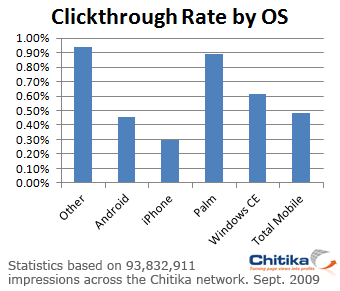
Web advertising company Chitika have published data showing that people are only half as likely to access advertising from mobile phones than from computers. OK. Less easy to interpret is that click through is lower on iPhones than on other operating systems.
In contrast their data confirm other findings that there is more web browsing on iPhones than on other handsets: So, what explains these strange results? Well, the advertising content tested wasn't particularly tailored to mobile use: none of the context-based offers that typically tempt mobile users. So that explains the main trend in computer access.
On the iPhone versus other handset issue ,it could be that the facility for focusing Safari on the content you are interested in screens out advertising, although some Techcrunch commentators modestly conclude iPhone users are just more discerning than users of other systems. Altogether, hard to interpret.
AP report that software used by parents in the US to monitor their children's web use (brand names Sentry and FamilySafe) is also collecting data about kids' IM conversations, which it is selling to advertisers to assist their targeting. Ugh. There is an opt out for parents but it's not exactly obvious (you could imagine particularly not to an over-anxious, not very web literate parent). There's a sort of irony in this, given current sentiment about over-protective parenting on the web. But it still sounds unacceptable.
I had never heard of doubleTwist (a package that makes it possible to run iTunes on any device). At least I hadn't until BoingBoing featured a story about BART apparently frustrating doubleTwist's attempts to advertise at a Powell Street station near San Francisco's Apple Store (and over the period that Apple is holding its developers conference).
I recently came across IKEAhacker where people describe their adaptations of IKEA furniture, some of them incredibly detailed. The site's been going strong for 3 years now.
Interesting to consider how a company like IKEA will survive recession: will it thrive, like the Poundshops and Primark because it's cheap, throw away (see IKEA's throw-away philosophy writ large in this Spike Jonze ad); or will people switch to the sustained value of higher quality goods as Linda Grant, provocatively, insists?
I think old habits die hard. And buying cheap is an established habit now. Maybe we'll add value by customising like the IKEA hackers. In Pine and Gilmore's classification that puts us somewhere between agrarian and industrial consumers, maybe edging into the service economy, far 'behind' the experience economy consumers they envisaged. (I have never found them convincing, perhaps because I wasn't the target audience for many of their shining examples of the experience economy at work. Service I can believe in; experience seems too intrusive and time-consuming and, to use their term, often inauthentic.)
Useful listing on Mashable of well-knowns brands' forays into social media, some very sophisticated. It's worth remembering, though, that all these brands (Dell, Blendtec, Burger King etc.) have customers who live their lives without any engagement with social media. Obviously their customer segmentation will be dealing with this, but there's a potential marketing digital divide here.
An aside: I looked at Burger King's somewhat tasteless 'Whoppervirgins.com' video (screen shot above), where people who have never eaten burgers before, i.e. who live in very poor countries, are filmed having their first taste of a BK 'Whopper'. After watching the vignette of 'Marylin, Independent Researcher', I expected Sacha Baron-Cohen to appear at any moment.
I'm a psychologist and, having worked for many years in the design of user-centred products and services, am now Professor of User-Centred Design at University of Reading, UK.
Why Brain Attic?
In 'A Study in Scarlet' Arthur Conan Doyle wrote: "I believe that a man's brain is like a little empty attic, and you stock it with such furniture as you choose....the skillful workman will have...nothing but the tools which will help him doing his work..."
As we now know, Conan Doyle's analogy doesn't quite tell the full story of the brain but nevertheless this blog is a place for me to store notes that, if not logged here, might be forgotten.









 Posts
Posts

