Showing posts with label Computer tyranny. Show all posts
06 June 2014
Gangnam opportunity cost
The Economist has mapped the aggregated time spent watching 'Gangnam Style' on YouTube to other projects which have demanded much human time and effort.
Via Tim Harford
Labels:
Computer tyranny,
Data,
Humour
13 October 2011
Donald Knuth on email
"Email is a wonderful thing for people whose role in life is to be on top of things. But not for me; my role is to be on the bottom of things. What I do takes long hours of studying and uninterruptible concentration. I try to learn certain areas of computer science exhaustively; then I try to digest that knowledge into a form that is accessible to people who don't have time for such study."
Alex Pang, who is writing a book on Contemplative Computing, has posted this lovely quote on Facebook, presumably from an interview with Donald Knuth; and a link to earlier comments on Knuth's (1990s) Stanford web pages.
26 May 2010
22 May 2008
Catholic Mac, Protestant PC
Lovely post by John Naughton, citing Umberto Eco's 1994 essay on why Macs are Catholic, PCs Protestant. Windows, apparently, is 'an anglican-style schism, big ceremonies in the cathedral.'
Labels:
Computer tyranny,
Humour
16 May 2008
Software etiquette
I like the description of polite and impolite software in an article by Whitworth and Liu on Politeness as a Social Computing Requirement. They cite Microsoft's habit of initiating software updates without asking the user's permission first as an example of impolite computing. Too right, especially when you haven't noticed it's happening in the background and the computer suddenly closes down to re-start after updating. Infuriating.
I guess the Dell insurance sales pitch I mentioned in March could qualify for the description 'impolite.'
Labels:
Computer tyranny
23 March 2008
Dell's temptation

Have just been ordering a new laptop and marvelling at the number of optional ad-ons Dell confuse you with after your main purchasing decisions. This picture almost tempted me to additional insurance.
Labels:
Computer tyranny,
Instructions
05 June 2006
What a holiday means
You might have noticed the long break. Nice piece by Mark Glaser on managing to turn off technology. (Someone at some point will quote turn on, tune in, drop out.)
Labels:
Computer tyranny,
Mobile phones
09 May 2006
Precise prescriptions
Radio 4's Casenotes describes a robotic drug dispensing system designed to reduce human error in hospital pharmacies. The system reads barcodes on packaging and picks and delivers the drugs to the pharmacist's work station. However the robot is limited by packaging size: it can't pick small packages. Sounds like a design opportunity.
One nugget that I picked up in the programme was that it wasn't until 1972 that drug packaging was required to display the name of its contents (and indeed I can remember medicine bottles saying just 'The mixture').
Labels:
Bar code/RFID,
Computer tyranny,
Instructions
28 April 2006
All in a name
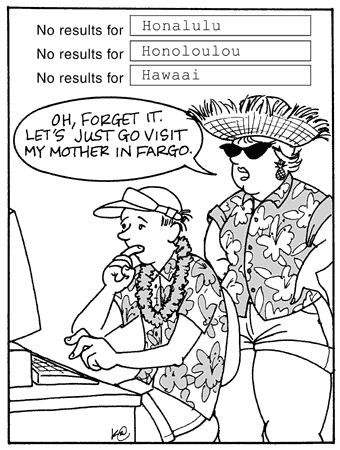
Apparently one of the difficulties Charles Clarke's team is facing in tracing the offenders who were released rather than deported is that Home Office computers don't have full records of their names. Reminded me of this cartoon from Jakob Nielsen's web site useit.com.
Labels:
Computer tyranny,
HCI,
Humour
25 April 2006
New technology and the brain
Big title for a big topic which Baronness Susan Greenfield discussed in a question (in the House of Lords last Thursday) on changes in information access and education. Jackie Ashley gives the speech a sympathetic review in Monday's Guardian.
I have no doubt that our thinking is shaped by the tools we use (we also choose the tools that suit our thought processes). And it may be that (as easyMoney seems to think) technology shapes our social behaviours too (in the same way there's some choice in there too). So, yes, we need to think about how to get the best out of the technologies available to us (computers, cars, phones, medical technologies etc.).
But I do worry about suggestions (both in Greenfield's speech and Ashley's review) of a causal link between computer use and attention deficit and hyperactivity, no matter how tentatively phrased. Mindhacks points to studies that suggest, at best, ambiguity in the link between computers and ADHD-style symptoms.
It might be worth looking back at Sherry Turkle's 1980's study of MIT computing nerds, The Second Self. Rather than suggest that computers shaped their users' behaviour Turkle showed how computers gave space for behaviours that were already there (obsessive and asocial, and, incidentally, highly focused) to develop.
I have no doubt that our thinking is shaped by the tools we use (we also choose the tools that suit our thought processes). And it may be that (as easyMoney seems to think) technology shapes our social behaviours too (in the same way there's some choice in there too). So, yes, we need to think about how to get the best out of the technologies available to us (computers, cars, phones, medical technologies etc.).
But I do worry about suggestions (both in Greenfield's speech and Ashley's review) of a causal link between computer use and attention deficit and hyperactivity, no matter how tentatively phrased. Mindhacks points to studies that suggest, at best, ambiguity in the link between computers and ADHD-style symptoms.
It might be worth looking back at Sherry Turkle's 1980's study of MIT computing nerds, The Second Self. Rather than suggest that computers shaped their users' behaviour Turkle showed how computers gave space for behaviours that were already there (obsessive and asocial, and, incidentally, highly focused) to develop.
Subscribe to:
Posts (Atom)