Showing posts with label Texting. Show all posts
Showing posts with label Texting. Show all posts
08 October 2009
SMS embedded in everyday life
I reflected recently on how the 'Texting' category of this blog has so few entries, particularly few added recently. Texting is so embedded in everyday life (and the texting multi-taskers I commented on in 2007, so commonplace) that it barely merits comment. To prove the point this post on Mashable reports that in the US 4.1 billion texts were sent daily in the first half of 2009, almost twice the number sent in the same period of the previous year. Even bearing in mind that America has been slower to take up texting than the UK, and sceptical as one might be about the industry's own surveys of itself (this is by CTIA which represents the US mobile industry to government), it's a huge jump. Mobile broadband access is also increasing signicantly.

12 January 2009
Phones that require two hands
John Naughton, of whom I'm a fan, is dumping his Google Android. Mainly for hardware reasons. One of his complaints is that the keyboard requires two hands to operate, making single-handed texting impossible. When calling, texting (and alarm clock) are still the staples of mobile phone manufacturers are playing with fire to compromise them in any way. Tomi Ahonen has always been a proponent of single-handed phone use (and, indeed, of 'blind' texting), and critical of the iPhone because interactions require both hands and eyes.
17 November 2008
Geolocalisation - when you want it
I loved this approach to geolocalisation by Finnish innovators Puskaradio. You download their application to your phone. Whenever you want to tell people where you are you use it to send an SMS to them. The service then picks up your GPS location and provides the recipient with a map of where you are. I like the fact that it's not always on, and your location is only made available to the specific individuals you want to see it. Basically you're in control. Once downloaded it's as easy to use as a text message (and while downloading itself may be less than straightforward, their step by step user-guide seems to handhold through the process).
(Am slightly less enamoured by their insistence that it's so easy even your mother can use it.)
(Am slightly less enamoured by their insistence that it's so easy even your mother can use it.)
06 July 2008
The antecedents of txtng
John Naughton reports on David Crystal's recent article on the language of text messaging (2 b or not 2 b), in which he draws together the historic antecedents of abbreviated language. It was sweet to be reminded of the rebus popular in my childhood: yy u r yy u b i c u r yy 4 me.
13 May 2008
Texts cost more than space data
Nigel Bannister, space scientist at University of Leicester, has found that sending data via SMS (at 5p per message) is four times as expensive as the transmission of space data from the Hubble telescope.
30 November 2007
What's new in phone text entry systems
Review in FT of developments in text entry systems for mobile phones. I refer to the review in a Shift6 posting discussing how observational research can impact product and service development.
26 March 2007
Multi-tasking - don't
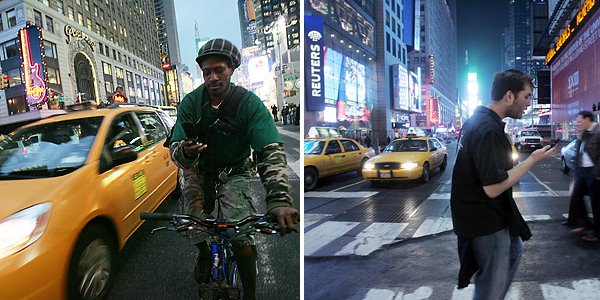
Review article in NY Times on the impact of multi-tasking on productivity. Includes an image of someone texting whilst cycling through Manhattan. I've seen similar here in leafy Reading, and even here it looked pretty hairy.
30 June 2006
If you're not texting at the moment...
...you may have time to read these statistics from the Mobile Data Association. It seems people in Britain aren't doing much else.
30 April 2006
Regional accents
Ofcom's survey of use of communications channels across the UK reveals that 28 texts are sent for every 20 mobile phone calls in the UK, with the exception of London where mobile voice calls exceed texting. People in Northern Ireland and the East Midlands send the most texts. Hard to propose explanations here! In Scotland, Yorkshire and the Humber, uptake of landlines is lower than the national average (91%) with people relying on mobiles.
Internet take up is higher in rural areas than in urban area, with Scotland showing the highest access to (though not necessarily uptake of) broadband.
While London has the highest spend on communications, as a proportion of household income, that spend is relatively low compared to the nation as a whole (with Wales and Northern Ireland spending the highest proportion).
What do these data (and all the other data from the survey) add up to? At minimum that business decisions made on the basis of London-based focus groups might be a little shakey.
Internet take up is higher in rural areas than in urban area, with Scotland showing the highest access to (though not necessarily uptake of) broadband.
While London has the highest spend on communications, as a proportion of household income, that spend is relatively low compared to the nation as a whole (with Wales and Northern Ireland spending the highest proportion).
What do these data (and all the other data from the survey) add up to? At minimum that business decisions made on the basis of London-based focus groups might be a little shakey.
Subscribe to:
Posts (Atom)

 Posts
Posts

