Michelle Meyer writes in defence of the Facebook/Cornell study on people's response to the emotional tenor of their Facebook feeds. She argues the manipulation of individuals' news feeds wasn't much beyond the everyday experience of Facebook and, yes, a little ethical review and participant briefing might have been nice but let's not let over-sensitivity get in the way of corporations doing what, apparently, they must.
via Ed Yong
Showing posts with label User generated content. Show all posts
Showing posts with label User generated content. Show all posts
25 July 2014

18 November 2013
Dopplr's passing

15 November 2013
Nominet UK's top 100 social technology enterprises

An eclectic list, presented idiosyncratically (the tiled layout, amongst other things, limits each entry to four classification categories; if tile size is of significance that beats me). But an interesting few moments' browsing. Charlie Leadbeater's description of the selection process provides some useful background.
20 March 2012
Encyclopaedias and their successors
Tim Carmody argues that Britannica didn't fall specifically to Wikipedia but, more generally, to the PC, as the tool parents buy to enhance their children's prospects. Wikipedia simply administered the final blow. Some nice musings on Britannica and reference tools generally as domestic status objects: Britannica sold $250 worth of books for $1500; apparently the books were rarely opened. (But at least, when opened, more use than the leather bound phone books filmed as Dumbledore's spell books.)
[via StatusQ]
[via StatusQ]
18 October 2011

08 September 2011
Michael Stern Hart
...who quietly invented ebooks, 30 years ago, died on 6 September. He recalled 'I envisioned sending the Declaration of Independence to everyone on the net... all 100 of them... which would have crashed the whole thing...'. This toe in the water led to Project Gutenberg, run by volunteers and, currently, the largest repository of free books. Its mission statement is delightful including it's management policy, written by Hart:
Because we are totally powered by volunteers we are hesitant to be very bossy about what our volunteers should do, or how to do it.
[via Guardian books]
Because we are totally powered by volunteers we are hesitant to be very bossy about what our volunteers should do, or how to do it.
[via Guardian books]
03 July 2011
Effort in electronic communication reaps reward
The more effort made to personalise a communication, the more likely it is to be read. Laurent Haug, founder of the Lift conference notes that longer and more personal communications receive more comment.
"For a long time, the Lift page [on Facebook] was managed manually. I would replicate each article carefully, adding a custom message different from the title of the news I was pushing to the community. As soon as we installed an automatic app (RSS graffiti) to republish articles automatically, the number of interactions almost halved."
Haug concludes that social technologies will never be magical. Surprise...or maybe just not magical enough, yet.
[via Alex Soojung-Kim Pang]
"For a long time, the Lift page [on Facebook] was managed manually. I would replicate each article carefully, adding a custom message different from the title of the news I was pushing to the community. As soon as we installed an automatic app (RSS graffiti) to republish articles automatically, the number of interactions almost halved."
Haug concludes that social technologies will never be magical. Surprise...or maybe just not magical enough, yet.
[via Alex Soojung-Kim Pang]
09 June 2011
Viral whiteboards on the Tube

Going Underground has been documenting the recent spate of philosophical thoughts appearing on the Tube's service information whiteboards (including the homage to information design, above, captured by Tom Philips).
My favourite, though, expresses a somewhat more down-to-earth sentiment (picture by Blake Conolly):
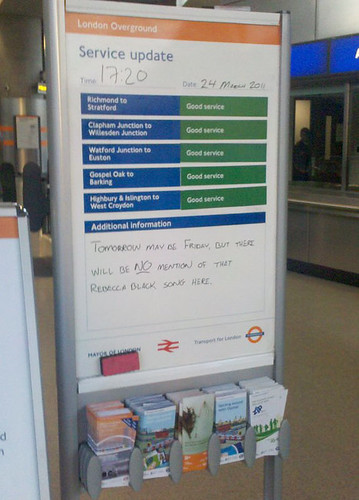
Legibility not great but it says: Tomorrow may be Friday but there will be NO mention of that Rebecca Black song here.
In 1993, I worked on a Customer Information Strategy for London Underground, aimed at improving the organisation's communication, across all media, with its customers. When we recommended, then, improving the use of whiteboards, this wasn't quite what we had in mind. But that was back in those austere days before Pyne and Gilmour. (Nice to see, though, Oval making such good use of the ruled whiteboards, which we endorsed because they improved the legibility of hand-written messages. Not so sure about the gothic script.)
For even more whiteboard 'experience', see here.
[via David Woodward on Facebook]
04 February 2011
Crowdsourcing produces effective articles
Writing can be a chore but research by Aniket Kittat at CMU compared articles produced by crowdsourcing sub-components of the writing task (e.g. producing an outline, researching topics, writing up the article) to crowdsourced articles produced by single authors and articles in the Simple English Wikipedia. Readers rated the articles that had been written by multiple authors higher than the individually-written articles and equivalent to the Simple English Wikipedia. Kittur proposes crowdsourcing writing components as a fruitful way of overcoming crowd workers' reluctance to take on difficult and low-paid tasks (such as article writing) as a whole. Extending the process to researching a purchase (comparing information for three family cars) Kittur found that individual crowd workers simply would not take on the task as a whole, but research summaries could be produced, again by breaking down the task and crowdsourcing it.
[via ACM Technews]
[via ACM Technews]
31 January 2011
From Design of Understanding (Choosing communication channnels)
Chris Heathcote's presentation from Design of Understanding is here. I like his comment, slide 10, on the 26 options for communication his iPhone presents, 'humans are great at understanding just the right way to communicate with the right person in the right context'. Individuals, yes, mostly; organisations, less so.
Eva-Lotta Lamm's sketches capture the talks from the conference. Some of the sketches are easy to read to a non-attender (probably partly depending on the clarity of the speaker's argument).
As an aside on sketch notes, I've commented before on the distraction of real-time sketching for talks (note Eva-Lotta's are not real-time); more recently, note the distracting animations for Jimmy Wales' talk on The State of Wikipedia. Maybe I have had too much training as a radio listener but the content is interesting enough without the accompanying visual stream...and competing sound track. In this case not 'just the right way to communicate'.
Eva-Lotta Lamm's sketches capture the talks from the conference. Some of the sketches are easy to read to a non-attender (probably partly depending on the clarity of the speaker's argument).
As an aside on sketch notes, I've commented before on the distraction of real-time sketching for talks (note Eva-Lotta's are not real-time); more recently, note the distracting animations for Jimmy Wales' talk on The State of Wikipedia. Maybe I have had too much training as a radio listener but the content is interesting enough without the accompanying visual stream...and competing sound track. In this case not 'just the right way to communicate'.
12 January 2011
Tagging human knowledge
Summary talk by Paul Heymann of research at Stanford looking at web corollaries to physical book browsing in library stacks. His team have found that tags for book content (either Library of Congress or user-generated tags (including tags generated through Mechanical Turk)) help users find books they might otherwise not have accessed, and that medium frequency tags carry the information that is the most useful in helping people find the specific books they need.
[via InfoDesign]
[via InfoDesign]
07 January 2011
What the web is for

According to Paul Ford, the web's unique quality is to satisfy our need to be consulted, the WWIC (why wasn't I consulted) need. In Ford's view WWIC accounts for web phenomena from Wikipedia, YouTube etc. to Ebay, Digg and Amazon.
Maybe. I wouldn't make the claim so strongly. But it's a useful shorthand, along the lines of '15 minutes of fame', and I'm sure will be much quoted.
The illustration comes from a charming comment on the news of Clive Sinclair's marriage. Makes Ford's point beautifully.
[via Tim O'Reilly]
07 October 2010
Noel Coward on Facebook
Discussing his personal use of Facebook, Quentin Stafford-Fraser alludes to a comment on television attributed to Noel Coward:
"...television is for appearing on - not for looking at".
"...television is for appearing on - not for looking at".
30 September 2010
Talking about data visualisation
Good podcast by Involution Studios, including a discussion about data visualisation, which works remarkably well despite being in audio only, because of the index of links Involution provide. The three discussants (Brian Staats, Irene Ros and Michael Dila) covered the opportunities for giving access to public information (and also obfuscating it) that data visualisation brings, the varied backgrounds (often more statistical than design-based) that data visualisers have, the need for people to be educated to be able to read visualisations critically. Their discussion, of course, mentioned both Edward Tufte and Hans Rosling and led me to Rosling's recent, wonderful visualisation of population growth, using IKEA storage boxes (above).
From the podcast I linked to a talk by Nick Felton (of the Feltron Annual Report), information designer who has collaborated Rob Deeming and Ken Riesman (with backgrounds in natural language processing and algorithmic methods) on a project called 'What we are saying', comparing (and visualising) the front page stories of the NY Times and other news sources with user-generated content on Twitter and blogs. Some of their less expected findings for me were that whereas coverage of front page stories is pretty much evenly shared across topics, user-generated content has much stronger biases (in the sample week they covered, healthcare was the topic for 27% of UGC, compared to 19% of news stories) and that, generally, UGC expresses more positive sentiment than the news (maybe this is less suprising).
(Note Ken Riesman has created Pluribo, which looks at Amazon reviews of products and produces a short, digestible precis. Unfortunately I couldn't get it to work. Would be a wonderful tool for managing reading certain kinds of UGC if it did.)
01 September 2010
What a coffee table e-book can do
Excellent Robert Scoble interview with Jean-Marie Hullot about his development of Fotopedia Heritage, an interactive compilation of photos of UNESCO World Heritage sites, compiled by photographers, app curators and the communityof users, and linked to aggregated information (currently drawn from UNESCO, Wikipedia and TripAdvisor) about each site. This is a first step towards personalised travel guides, and other applications Hullot has yet to reveal. Hullot describes how the essential components of the 'book', community, curation and iPad (or iPhone) technology are bound together by his team's understanding of software, a capacity he feels traditional publishers still lack.
Aside from the technical merits of the application, the delicious presentation of the photos (which are curated rigorously for quality) sent me straight to Google with thoughts (ahead of Hullot's travel application) of future destinations.
[via John Naughton]
13 August 2010
The characteristics of Twitter use
Psyblog has put together a list of 10 findings from research on Twitter users' behaviour. Despite describing Twitter, rather nicely, as like being at a party and having several conversations with people at one time, he concludes that Twitter is 'less social' than other social networks, demanding less personal information from users, and exhibiting less reciprocation in followers/following and also in responses to tweets.
One element of this non-reciprocity is the following celebrities have. But they're not the only people with large followings. Others 'earn' their following by tweeting interestingly. Psyblog continues: "Occasionally, though, some manage the trick of being famous and quite interesting, e.g. Stephen Fry". Agreed. (Note Psyblog doesn't mention recent research by HP labs showing that number of followers isn't an index of influence on Twitter; that's determined by how much an individual is retweeted.)
Psyblog also points to the Pulse of the Nation analysis and visualisation of the mood content of 300 million American Tweets, carried out by computer scientists at North Eastern University and Harvard Medical School, which shows, so eloquently, changes in mood with time of day and day of the week.
[Psyblog article via Mindhacks; HP research via ReadWriteWeb]
07 April 2010
Deceit and technology
Talking of pictures, Jeff Hancock of Cornell University has given a fascinating talk at Harvard's Berkman Center. Hancock's team has analysed the photographs typically used on internet dating sites, as part of a series of studies of technology and deceit. Typically daters choose pictures that are 17 months out of date. They also lie systematically about their weight and height, but not about their age, which can be verified more easily and where the consequences of lying may be more damaging to the individual. Lies, across all media, are small but frequent, and are mediated across media, according to ease of detection (guilty, as charged, of texting 'on my way' when I've not even set out).
Hancock's team have also looked at the linguistic attributes of lies, which include less frequent use of the first person than in other contexts and use of negative language. It's possible this sort of analysis, alongside understanding the profile of contributors, could help authenticate user generated content.
Hancock's team have also looked at the linguistic attributes of lies, which include less frequent use of the first person than in other contexts and use of negative language. It's possible this sort of analysis, alongside understanding the profile of contributors, could help authenticate user generated content.
09 October 2009
'News' snapshot across media
 The Pew Centre's Project for Excellence in Journalism has published a recent snapshot (lovely bar charts) of the main stories across different media in the US: blogs, print journalism and Twitter. Some interesting contrasts, with the human/Hollywood Polanski story dominating blogs (personally, don't want to give the man any more space here), health care dominating in print, and Google Wave on Twitter. All of which shows a, perhaps unsurprising, segmentation in people's use of different media; not necessarily, imo, that the media world is dividing up into discrete segments. That may be part of the story (particularly the pattern for Twitter) but I think people are looking to different formats for different things. The blogging graph suggests which part of traditional media might most feel under threat from new media, though.
[via John Naughton]
21 September 2009
Mendeley - active on-line bibliography
 Have just installed Mendeley, on-line tool from the creators of Last.fm which, similarly, allows you to create and organise a personal library of the papers you use on-line, see what are the 'favourite' papers within a discipline (and follow/shape those trends), share libraries with others, annotate and tag your papers, import them as references directly into documents you are producing etc. Can see it being a brilliant teaching and research tool, with implications for how research is disseminated (and long term for traditional measures of research impact, such as citations). As of 11 September the tool had 4 million references in its database. Sounds big, and it's currently doubling in size every eight weeks (listen to Vic Keegan's interview with founders Jan Reichelt and Victor Henning).
My first difficulty with it was having to select a discipline to tag myself with (it was ever thus). Opted for psychology and will see how that works out.
Later: Having browsed Mendeley, find its largest user groups (of a community of roughly 25,00 users) are biological scientists and, not surprisingly, computer and information scientists (psychologists have a respectable presence; designers, a select few). Find that, at this stage of its development, the temptation is to look at the 'most read' articles, the first of which Defrosting the digital library is an excellent introduction to the challenges and opportunities facing Mendeley and its competitors. The last thing I'd be likely to be doing on Last.fm would be listening to the most listened to track.
18 September 2009
The reliability of user reviews
Technology Review reports Vassilis Kostakos' analysis of user reviews on Amazon, Internet Movie Database and BookCrossings. On all sites he found that a small core of users submitted multiple reviews (for example, only 5% of Amazon users submit more than 10 reviews). So reviews you read don't come from an exactly representative population (nor, of course, do the professional reviews in papers and magazines but, there, the expectation is different). However the impact of a core of active contributors seems to be a common issue for user-generated content.
The TR report mentions tools that can be used to 'frame' reviews for readers, for example, dating the review, giving user ratings of the helpfulness of the review. Kostakos suggests eliminating extreme reviews in either direction, to prevent a group effect of followers taking the lead from an extreme view, although Jahna Otterbacher (who studies on-line rating systems) suggests this might put people off contributing.
Some interesting comments beneath the main report, one of which points out that what is needed is research into the strategies people use in interpreting the reviews. I know I have many, and they vary according to the site I'm using. So, for example, using Trip Advisor I'll look at where the reviewer comes from to see whether they might carry the same cultural baggage as me. On Amazon I tend to look for any hint of a link between the reviewer and the author. A link isn't necessarily negative in my mind, indeed it can add to appreciation of the book: see this review of Keeping Mum by cousin of the author, Brian Thompson:
Although it may seem cheeky reviewing my cousin's book, I feel I must for several reasons...
Later: ReadWriteWeb has also picked up this research, with more interesting comments.
[Via Putting People First]
The TR report mentions tools that can be used to 'frame' reviews for readers, for example, dating the review, giving user ratings of the helpfulness of the review. Kostakos suggests eliminating extreme reviews in either direction, to prevent a group effect of followers taking the lead from an extreme view, although Jahna Otterbacher (who studies on-line rating systems) suggests this might put people off contributing.
Some interesting comments beneath the main report, one of which points out that what is needed is research into the strategies people use in interpreting the reviews. I know I have many, and they vary according to the site I'm using. So, for example, using Trip Advisor I'll look at where the reviewer comes from to see whether they might carry the same cultural baggage as me. On Amazon I tend to look for any hint of a link between the reviewer and the author. A link isn't necessarily negative in my mind, indeed it can add to appreciation of the book: see this review of Keeping Mum by cousin of the author, Brian Thompson:
Although it may seem cheeky reviewing my cousin's book, I feel I must for several reasons...
Later: ReadWriteWeb has also picked up this research, with more interesting comments.
[Via Putting People First]
Subscribe to:
Posts (Atom)

 Posts
Posts

