Michelle Meyer writes in defence of the Facebook/Cornell study on people's response to the emotional tenor of their Facebook feeds. She argues the manipulation of individuals' news feeds wasn't much beyond the everyday experience of Facebook and, yes, a little ethical review and participant briefing might have been nice but let's not let over-sensitivity get in the way of corporations doing what, apparently, they must.
via Ed Yong
Showing posts with label Psychology studies. Show all posts
Showing posts with label Psychology studies. Show all posts
25 July 2014

22 April 2014
10,000 hours of practice – unpicked
Nice pop explanation at Salon of the need for quality, spaced practice, not just massed practice. This is one of my favourite, non-intuitive and robust psychological phenomena, first demonstrated in the late 19th century (by Ebbinghaus) and replicated in multiple studies subsequently.
[via Katja Battarbee]
[via Katja Battarbee]
16 April 2014
Of marginal significance...
Have been wondering about the term 'marginally significant' used in research papers. It's a term that wasn't used when I learned statistics a very long time ago. Research results were either significant, at a given level, or not. So I browsed the term and found it is, indeed, acceptable in some settings, for reporting 'non-critical results' (you define what's critical).
Then I found this lovely analysis by epidemiologist, Matthew Hankins, of the p values at which effects are described as marginally significant. I love the annotations.
 And some detailed discussion by Hankins here.
Also a very nice video, 'Dance of the p Values', by Geoff Cumming which starts in the same vein has Hankins' diagram.
Then I found this lovely analysis by epidemiologist, Matthew Hankins, of the p values at which effects are described as marginally significant. I love the annotations.
Also a very nice video, 'Dance of the p Values', by Geoff Cumming which starts in the same vein has Hankins' diagram.
07 December 2013
The file drawer problem
The Economist's recent article How science goes wrong is a useful reminder of publication biases in science. It recently came up in a discussion at work, which took me back to Rosenthal's paper on 'the file drawer problem' (null results in science are seen as boring and unpublishable, so tend to get filed away, while the study or its analysis is tweaked to produce something that shows a significant effect). Rarely mentioned in research methods teaching.
Rosenthal, R. 1979. The file drawer problem and tolerance for null results. Psychological Bulletin 86/3, 638–641
Rosenthal, R. 1979. The file drawer problem and tolerance for null results. Psychological Bulletin 86/3, 638–641
12 June 2013
The impact of introspection on preference choices
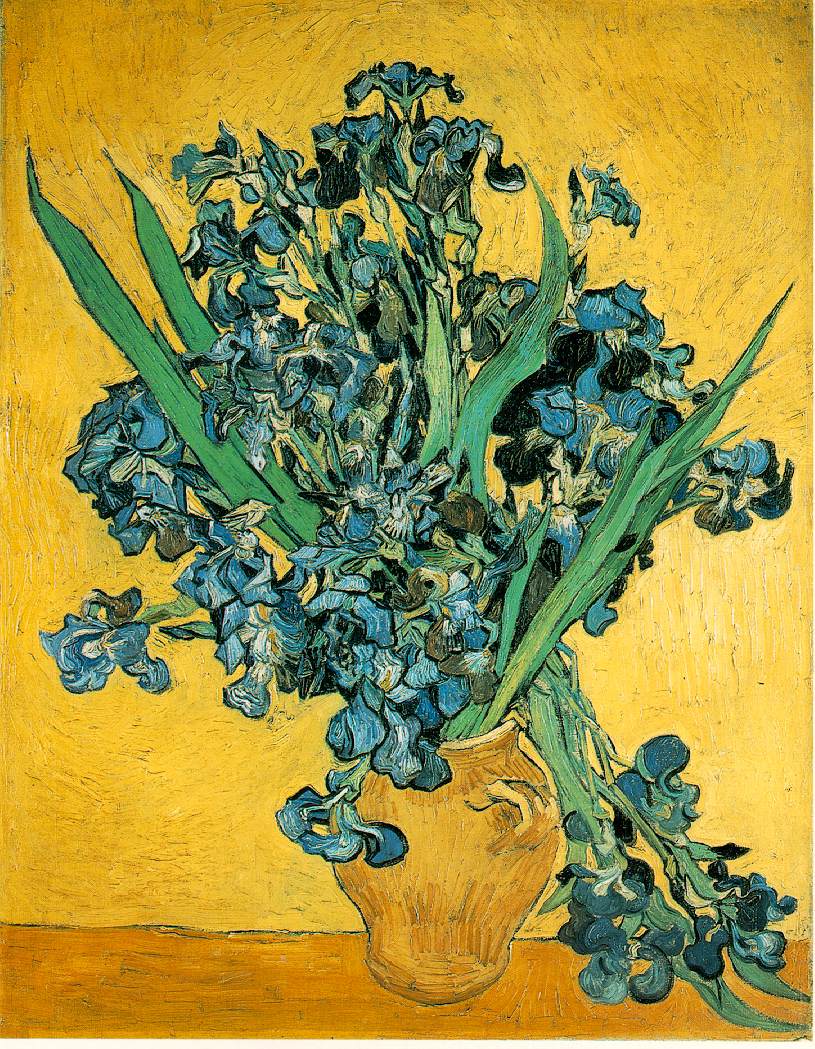 |
| Van Gogh's Irises, from the Rijksmuseum, Amsterdam |
Worth bearing in mind when carrying out studies of visual attributes, as I so often do, that require participants to explain their preferences and choices.
[via Mindhacks]
20 November 2011
Pareidolia

MindHacks can't see Elvis in this potato crisp (picture from a study by Voss et al.) but he's certainly there. A great example of pareidolia.
18 July 2011
Search alters memory
Apparently, according to research by Betsy Sparrow at Columbia University and reported by Wired, Ed Yong and in many other places. Using a Stroop test Sparrow found that, when presented with questions that were difficult to answer, students tended to think of computers (i.e. took longer to name colours used for words such as 'Google, browser or computer' than for words less connected with computers).
In a different study, Sparrow asked students to type out a set of unrelated trivia statements and found that those students who had been told the statements would be stored on a computer remembered less of the detail of those statements than those told that the statements would be deleted. Sparrow hypothesises that people use computers as a source of transactive memory - i.e. like a member of a social group who can be relied upon to remember detailed information. Sparrow tested this further in a study where, following typing a trivia statement, students were told the statement would be deleted, or stored in a specific folder. Students remembered more of the statements they had been told would be deleted than those they had been told would be saved, but their memory for the locations that the statements had been saved to was, however, rather good.
Everyone is at pains to say that memory is not getting worse because of computers, just different. Sparrow suggests that human memory is adapting to the tools available, remembering where information is, rather than its content. Yong comments that as location (i.e. specific folder information) becomes less significant in systems that enable search across all kinds of locations, remembering the key words used for searches may become more important than remembering file locations.
In a different study, Sparrow asked students to type out a set of unrelated trivia statements and found that those students who had been told the statements would be stored on a computer remembered less of the detail of those statements than those told that the statements would be deleted. Sparrow hypothesises that people use computers as a source of transactive memory - i.e. like a member of a social group who can be relied upon to remember detailed information. Sparrow tested this further in a study where, following typing a trivia statement, students were told the statement would be deleted, or stored in a specific folder. Students remembered more of the statements they had been told would be deleted than those they had been told would be saved, but their memory for the locations that the statements had been saved to was, however, rather good.
Everyone is at pains to say that memory is not getting worse because of computers, just different. Sparrow suggests that human memory is adapting to the tools available, remembering where information is, rather than its content. Yong comments that as location (i.e. specific folder information) becomes less significant in systems that enable search across all kinds of locations, remembering the key words used for searches may become more important than remembering file locations.
14 March 2011
Hot air balloons and subversion
iPhone hack of advertising hoardings in Times Square, using a hot air balloon to raise a signal repeater to the hoardings' height.
May be a fake, but that's not the point. Reminds me of a picture that will be familiar to students of psycholinguistics (Bransford and Johnson (1972)). Contextual prerequisites for understanding: Some investigations of comprehension and recall. Journal of verbal learning and verbal behavior, 11, 717-726).
 [iPhone hack via iotwatch]
May be a fake, but that's not the point. Reminds me of a picture that will be familiar to students of psycholinguistics (Bransford and Johnson (1972)). Contextual prerequisites for understanding: Some investigations of comprehension and recall. Journal of verbal learning and verbal behavior, 11, 717-726).

08 March 2011
The relevance of cognitive science
Nice bit of balance from David Dobbs in Wired about the possibility of useful neuroimaging research (or 'blobology' as one of his commenters describes it).
Also worth reading is Jonah Lehrer's New Yorker article on the failure to replicate effects in published psychology studies; possibly a consequence of the bias that results from researchers' writing up studies with significant effects for publication, at the expense of many other studies without significant findings.
Also worth reading is Jonah Lehrer's New Yorker article on the failure to replicate effects in published psychology studies; possibly a consequence of the bias that results from researchers' writing up studies with significant effects for publication, at the expense of many other studies without significant findings.
28 January 2011
Poor memory for intentions
Research by Kaasa, Morris and Loftus shows that memory for past intentions is poor, but that asking people to recall intentions, and then asking them again at a later date introduces a (potentially bogus) consistency across the two recall sessions. (Worth noting that the recall task was linked to a relatively trivial decision (people's reasons for buying a particular piece of music) begging the question whether the results would transfer to more significant decisions, such as reasons for choosing a particular insurance policy etc.) The results are interpreted in the context of police proceedings, where consistency of recall is regarded as an indicator of accuracy, but the research should also give qualitative researchers pause for thought about the accuracy of the reflections they elicit.
[via BPS Research Digest]
[via BPS Research Digest]
17 January 2011
Good fonts bad fonts
Several people have asked me about the research that provoked Jonah Lehrer's 'demonstration' (on Radio4's Today programme) of the apparent enhancement of memory for text content by 'poor' legibility (i.e. less than typical text fonts). Lehrer's thesis: making the brain work harder to read these fonts increases processing and hence memory. Eventually I read the Cognition article that spawned Lehrer's blog post and subsequent appearance on Today (where he did, rather unfortunately, seem to present the science as if it was his own). As far as one can tell the research is intrinsically well-designed (without really seeing the materials, one's at a bit of disadvantage) but the speculation about the locus of the effect (along the lines of Lehrer's) and the implications for education are surprising. In the discussion there was no consideration of whether the supposedly less legible fonts were actually less legible or just 'different' and hence more memorable. And in the discussion there was no mention of the impact of typeface on assessment of the ease or difficulty of a text (see Song and Schwartz's review of type legibility on information processing) which would, in the long run, affect the real usability of unusual text fonts. It's a great undergraduate project but I feel Cognition's reviewers should have been a little more exacting.
Here's a summary of some of the comments I made when initially asked for reactions to the Lehrer interview:
- a shame that the BBC didn't think this merited inclusion of an additional point of view to Lehrer's, and indulged (probably encouraged) his bad science demo
- not surprising the Beeb picked up on the story because fonts are easy and fun to tweak in order to change document appearance, but document design is about so much more than just typeface choice (a lot should follow from that choice alone)
- shame the corpus of evidence that might provide an alternative perspective was only alluded to but not presented. One Today programme interview will likely influence many more than decades of scholarly texts and manuals
- Lehrer's initial example of 'easy' design that (in his view) led to poor information processing was reading in Arial on the Kindle. Not many text designers would recommend that as an approach to reading
- If you look at modern text book design (both the original article authors and Lehrer make much of the implications for designing text books) in fact all sorts of techniques of highlighting, illustrating etc. are used to make elements of text more distinctive and memorable. And, historically, designers have used the less legible italic version of fonts to make small elements of text more obvious and memorable
- 'reading' covers many activities, not just reading to memorise: browsing, searching, quoting, referring back etc.
- if the researchers had looked at text in, say, shocking pink they might have found a similar effect (a shame they didn't do this, actually, since it would have added another, helpful, dimension to the research). Would they have then recommended that books were all printed in colour?

All this aside, looking at the type of text teenagers many learn and revise from now (maybe the typical Princeton entrant didn't), it's clear book designers have got there first.
Here's a summary of some of the comments I made when initially asked for reactions to the Lehrer interview:
- a shame that the BBC didn't think this merited inclusion of an additional point of view to Lehrer's, and indulged (probably encouraged) his bad science demo
- not surprising the Beeb picked up on the story because fonts are easy and fun to tweak in order to change document appearance, but document design is about so much more than just typeface choice (a lot should follow from that choice alone)
- shame the corpus of evidence that might provide an alternative perspective was only alluded to but not presented. One Today programme interview will likely influence many more than decades of scholarly texts and manuals
- Lehrer's initial example of 'easy' design that (in his view) led to poor information processing was reading in Arial on the Kindle. Not many text designers would recommend that as an approach to reading
- If you look at modern text book design (both the original article authors and Lehrer make much of the implications for designing text books) in fact all sorts of techniques of highlighting, illustrating etc. are used to make elements of text more distinctive and memorable. And, historically, designers have used the less legible italic version of fonts to make small elements of text more obvious and memorable
- 'reading' covers many activities, not just reading to memorise: browsing, searching, quoting, referring back etc.
- if the researchers had looked at text in, say, shocking pink they might have found a similar effect (a shame they didn't do this, actually, since it would have added another, helpful, dimension to the research). Would they have then recommended that books were all printed in colour?

All this aside, looking at the type of text teenagers many learn and revise from now (maybe the typical Princeton entrant didn't), it's clear book designers have got there first.
01 November 2010
Skimming research findings
Just a note of Harry Brignull's comments on how much design research (especially in web design) is reported as press releases and 'top ten tips', without the context, study design, caveats and any counter findings, typical of scientific reporting, that help qualify the research. A comment by Rob Gillham points to this excellent example of the phenomenom (on a pet hobbyhorse: the impact of making people scroll to find information).
13 September 2010
Technology and children's brains
Much cited review in Neuron, by Bavelier, Green and Dye, on the impact of technology use on brain development. Reminding us that 'technology' encompasses many things, from watching Teletubbies to playing action video games, the review reveals that whilst there are both positive and negative impacts of technology use, these aren't always predictable, and not always sustained. Technology Review highlights some key findings, my favourite being that 'educational' technology games rarely deliver the brain enhancement they claim. The Baby Enstein series (which always seemed to me to be such an insult to neonatal brains) gets a particular bashing.
Myths about creativity and the brain
'...creative thinking does not appear to critically depend on any single mental process or brain region, and it is not especially associated with right brains, defocused attention, low arousal, or alpha synchronization, as sometimes hypothesized.'
Happy to see this conclusion in the abstract of a review by Dietrich and Kanso, published in Psychological Bulletin, of 72 studies of brain imaging and creative behaviour.
[via MindHacks]
Happy to see this conclusion in the abstract of a review by Dietrich and Kanso, published in Psychological Bulletin, of 72 studies of brain imaging and creative behaviour.
[via MindHacks]
26 August 2010
Focus in lifelogging and blogging
I recently read Sellen and Whittaker's excellent review of Lifelogging studies. Their key point is that, so far, prototypes haven't capitalised on what we know of how human memory works, for example
- that we store partial, associatively organised memories of events, rather than total, chronological capture- that although we want to recall things, we also want to reminisce, and reflect on our memories
- and that one of our challenges is not remembering things from the past, but remembering to do things in the future.
Some interesting details emerge (for example, Gregory Abowd's finding that lecture recordings don't significantly improve students' grades; that whereas trials show meeting recording is popular with participants, it has never caught on as a business tool).
Sellen and Whittaker make the distinction between passive 'lifelogging' and active 'blogging' in which we choose what aspects of our lives to record, one of which is, apparently, food. TechCrunch post on recent funding for food blogging service, Foodspotting, commenting 'Don’t even bother arguing about it. It’s just the way it is'.
And so it would seem: in yesterday's Guardian Martin Parr was encouraging readers to photograph their food:
"When you are away, why not record all of the food that you eat? If someone has spent a lot of time cooking a meal, or if you're going out for a treat, photograph the food. You could make a series of each breakfast, lunch and dinner that you ate. That would be fascinating."
Indeed.
- that we store partial, associatively organised memories of events, rather than total, chronological capture- that although we want to recall things, we also want to reminisce, and reflect on our memories
- and that one of our challenges is not remembering things from the past, but remembering to do things in the future.
Some interesting details emerge (for example, Gregory Abowd's finding that lecture recordings don't significantly improve students' grades; that whereas trials show meeting recording is popular with participants, it has never caught on as a business tool).
Sellen and Whittaker make the distinction between passive 'lifelogging' and active 'blogging' in which we choose what aspects of our lives to record, one of which is, apparently, food. TechCrunch post on recent funding for food blogging service, Foodspotting, commenting 'Don’t even bother arguing about it. It’s just the way it is'.
And so it would seem: in yesterday's Guardian Martin Parr was encouraging readers to photograph their food:
"When you are away, why not record all of the food that you eat? If someone has spent a lot of time cooking a meal, or if you're going out for a treat, photograph the food. You could make a series of each breakfast, lunch and dinner that you ate. That would be fascinating."
Indeed.
28 June 2010
What MRI scans show...and what they might in the future
Very nice exposition by Neurotopia of the limits of interpretation of MRI scans (what does it mean to say that an area of the brain is active; in what way, excitatory, inhibitory, modulatory?), and of new research by Karl Deisseroth and team showing that what we're seeing is excitatory behaviour and, furthermore, tracing the paths of the firing neurons (Deisseroth's technique involves infecting neurons with a gene producing light sensitive channels, extending right along each neuron).
All in rats, so far, which seems a far better place to be than making wild interpretations of scans of human brains.
[via Not Exactly Rocket Science]
All in rats, so far, which seems a far better place to be than making wild interpretations of scans of human brains.
[via Not Exactly Rocket Science]
22 June 2010
Homunculus demonstrated
 A study by Matthew Longo and Patrick Haggard demonstrates how the body is not mapped uniformly in the brain. The hands, useful things that they are, are represented across a markedly larger cortical area than many other areas of the body (face, in particular the mouth, and genitals are also over-represented compared to other body parts).
Longo and Haggard put people's hands under a surface and then asked them to mark on the surface where the ends of their fingers and knuckles were. They found that people's representations of their hands is distorted by an underestimation of hand length and overestimation of its width. This distortion isn't uniform across the hands (less distortion for the thumb and index fingers than the others), which maps on to people's sensitivity across the hands. Interesting to consider why we should underestimate in one dimension and over-estimate in the other.
[via Not Exactly Rocket Science]
18 May 2010
RIP Richard Gregory
 Richard Gregory, eminent experimental psychologist, died yesterday, aged 86. His most recent paper was published this year, it's title 'Is it more fun to be an artist or a scientist?' capturing the span of his work. This photo depicts him just as I remember him on the occasions I heard him give talks on visual perception. Obituaries here (TimesOnline) and here (MindHacks).
21 April 2010
Brain training - doesn't
The outcomes of the large-scale study, carried out as a collaboration between the BBC and MRC CBU were published today. Brain training exercises make you good at brain training exercises. But the skills don't transfer. There's continuing research, though, to see whether the exercises have an impact on brain degeneration in older people.
07 April 2010
Deceit and technology
Talking of pictures, Jeff Hancock of Cornell University has given a fascinating talk at Harvard's Berkman Center. Hancock's team has analysed the photographs typically used on internet dating sites, as part of a series of studies of technology and deceit. Typically daters choose pictures that are 17 months out of date. They also lie systematically about their weight and height, but not about their age, which can be verified more easily and where the consequences of lying may be more damaging to the individual. Lies, across all media, are small but frequent, and are mediated across media, according to ease of detection (guilty, as charged, of texting 'on my way' when I've not even set out).
Hancock's team have also looked at the linguistic attributes of lies, which include less frequent use of the first person than in other contexts and use of negative language. It's possible this sort of analysis, alongside understanding the profile of contributors, could help authenticate user generated content.
Hancock's team have also looked at the linguistic attributes of lies, which include less frequent use of the first person than in other contexts and use of negative language. It's possible this sort of analysis, alongside understanding the profile of contributors, could help authenticate user generated content.
Subscribe to:
Posts (Atom)

 Posts
Posts

