Showing posts with label Architecture. Show all posts

22 February 2012

More on brainstorming

MIT Building 20
Another piece, this time by Jonah Lehrer, that casts doubt on the effectiveness of brainstorms for idea generation. One of the points he misses, although he talks about the productive strengths of collocated interdisciplinary teams, is that brainstorms are often a microcosm of those teams, bringing together  people who work together, are comfortable with one another and share a set of goals, in many cases with clients or specialist outsiders who bring in new perspectives. (He cites a nice alternative analysis to the business and technology studies of team work that are usually quoted: sociologist, Brian Uzzi, found an increased likelihood of success for broadway musicals if they are created by teams who have worked successfully together before; with even greater chances of success if the team also includes the stimulus of new people.) So the point is not that brainstorms don't work, but that brainstorms as an isolated technique don't work.

Lehrer's article includes a lengthy description of Building 20 at MIT (pictured above), a legendarily uncomfortable but equally legendarily productive, temporary structure, that housed and serendipitously brought together a wide ranging group of scientists and technologists (including, incidentally, Noam Chomsky and Amar Bose). I work in a 1940s temporary structure (originally a prosthesis centre for injured WW2 airmen), with all that that entails for comfort, at least in Winter. I will keep Building 20 in mind.

18 May 2008

User-centred architecture

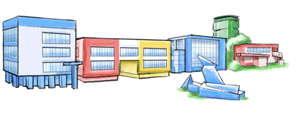
Interesting to note in the light of my comment yesterday on Barratt's new zero emission homes, that today is the 125th anniversary of Walter Gropius, whose influence resulted in much atruistic, but nevertheless inhuman, architecture. Looking at Google's Doodle for today I wondered if the edifice in front of the buildings was a collapsed human, worn down by the stress of living in a Bauhaus unit.

Thinking more about my comments yesterday I suppose part of my disappointment at Barratt's entry into green housing is their proposal's contrast to the excitement of the Peabody Trust's 2002 BedZed project.


This picture comes from BedZed resident, Paul Miller. As far as I know, six years on, the project is still a success, although I don't know the details of how it works for its residents.

17 May 2008

Will people want Barratt's zero-carbon homes?


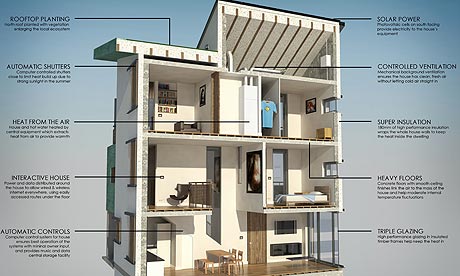
Barratt Homes has just announced its new, low-emission home, developed in conjunction with the Building Research Establishment. There are plans to build 200 at Hanham Hall, a redevelopment project just outside Bristol.

In a press interview, Mark Clare, Barratt's chief executive, commented that he thought the house would be successful as it had won 22,000 votes in a public competition last year: "We cannot and will not build houses that do not appeal to consumers. But they must also be affordable."

I wonder what other research they have done beyond public vote? I'd like to live in a lower emission house than I do presently. But there are several features of Barratt's proposal ,as far as one can tell from their schematic, don't appeal to me: from the (apparently) permanently sealed triple glazing (however fine-tuned the house's ventilation system, there will be times when people just want to open their windows); to the central computer in a cupboard under the stairs (presumably this device will need some programming, so why repeat the mistakes of old electricity meters etc. by putting it in an inaccessible place? I assume it's pretty small, so an accessible, no-fuss box would do); and it's hard to tell from the current illustration, but window sizes look small too. I also wonder whether Barratt will be planting sustainable gardens to accompany their houses. No mention of that in any of the press reports I've read.

So one to watch.

08 April 2006

The old and the new

Prompted by Designing a New World, the exhibition on modernism which opened at the V&A this week, Simon Jenkins has a tirade against modernism's lack of regard for tradition or comfort. It's easy to blame modernism for failing to incorporate human values but it's not the whole story. The modernists' passion for industrially-inspired solutions extended an enthusiasm for technology that was born in the Victorian age. And domestic design inspired by modernism has liberated women (in particular) from many of the chores required in the Victorian and Edwardian household.

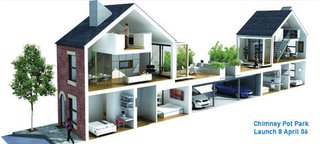
Jenkins cites the disastrous 1960s Hulme estate in Manchester as proof of modernism's shortcomings, but I think there were other factors there that might equally take the blame. Coincidentally, traditional back-to-backs, similar to those that were razed to make way for the Hulme's development, are now undergoing a renaissance just a few miles from (the now rebuilt) Hulme. Possibly as Jenkins was writing, people were camping out in Salford to try to reserve one of Urban Splash's houses in the Chimney Pot Park scheme where traditional back-to-backs have been gutted and fitted with a functional and distinctly modernist interior. At this stage of their implementation they seem a great combination of conservation and development.


(And a footnote: while the Victorians were enthusiastic about industrialisation they were also conscious of the need to conserve. According to Timothy Cooper, Victorian cities were "littered with 'dust yards' staffed by armies of underpaid and exploited women workers who were paid to sift through urban waste to recover items of value." ... a model which, without the underpaid and exploited workers(?), we are beginning to come back to through kerb-side recycling.)