Michelle Meyer writes in defence of the Facebook/Cornell study on people's response to the emotional tenor of their Facebook feeds. She argues the manipulation of individuals' news feeds wasn't much beyond the everyday experience of Facebook and, yes, a little ethical review and participant briefing might have been nice but let's not let over-sensitivity get in the way of corporations doing what, apparently, they must.
via Ed Yong
Showing posts with label social networking. Show all posts
Showing posts with label social networking. Show all posts
25 July 2014

18 November 2013
Dopplr's passing

15 November 2013
Nominet UK's top 100 social technology enterprises

An eclectic list, presented idiosyncratically (the tiled layout, amongst other things, limits each entry to four classification categories; if tile size is of significance that beats me). But an interesting few moments' browsing. Charlie Leadbeater's description of the selection process provides some useful background.
14 March 2012
If you're tired of TED...
...you may be right. Excellent review of TED, the phenomenon, suggesting that possibly the idea has spread a little too thin.
[via NotExactlyRocketScience]
[via NotExactlyRocketScience]
03 October 2011
Innovative uses of Google
I spotted this on Facebook
xxx: Every few weeks I speak to my aunt in Auckland on Skype and use its screen sharing feature to show her recent photos and talk through them. Yesterday we even used Google Earth to 'fly' over the Auckland suburb from which she recently moved, and where some of my family on my other side still live. To think that a generation ago contact with relatives abroad was limited to expensive phone calls and Aerograms. Thank you Skype creators.
yyy: have you ever played Google Streetview "This is your Life"? It's when you sit down with a friend or relative and have them "walk" you around the neighbourhood where they grew up. I did it with my parents recently. We flew around the Bronx (mum) and the Upper West Side (dad). Much had changed, but as it it with great cities, most places looked familiar. It was emotional.
Google are producing a quarterly glossy, thinkwithGoogle. Some nice articles but when they can generate spontaneous interactions like these one wonders why they need it.
xxx: Every few weeks I speak to my aunt in Auckland on Skype and use its screen sharing feature to show her recent photos and talk through them. Yesterday we even used Google Earth to 'fly' over the Auckland suburb from which she recently moved, and where some of my family on my other side still live. To think that a generation ago contact with relatives abroad was limited to expensive phone calls and Aerograms. Thank you Skype creators.
yyy: have you ever played Google Streetview "This is your Life"? It's when you sit down with a friend or relative and have them "walk" you around the neighbourhood where they grew up. I did it with my parents recently. We flew around the Bronx (mum) and the Upper West Side (dad). Much had changed, but as it it with great cities, most places looked familiar. It was emotional.
03 July 2011
Effort in electronic communication reaps reward
The more effort made to personalise a communication, the more likely it is to be read. Laurent Haug, founder of the Lift conference notes that longer and more personal communications receive more comment.
"For a long time, the Lift page [on Facebook] was managed manually. I would replicate each article carefully, adding a custom message different from the title of the news I was pushing to the community. As soon as we installed an automatic app (RSS graffiti) to republish articles automatically, the number of interactions almost halved."
Haug concludes that social technologies will never be magical. Surprise...or maybe just not magical enough, yet.
[via Alex Soojung-Kim Pang]
"For a long time, the Lift page [on Facebook] was managed manually. I would replicate each article carefully, adding a custom message different from the title of the news I was pushing to the community. As soon as we installed an automatic app (RSS graffiti) to republish articles automatically, the number of interactions almost halved."
Haug concludes that social technologies will never be magical. Surprise...or maybe just not magical enough, yet.
[via Alex Soojung-Kim Pang]
12 June 2011
Social media in academia
Starting with the premise that other information enterprises (news, book-selling, music) have seen changes with the rise of social media, and asking what will lies ahead for academic life, a Berkman Center panel brings together four Harvard professors, long-standing users of social media, to describe what social media they use and how (more blogging than tweeting, to be honest). There is a heartwarming, albeit somewhat edited, clip of a three way video seminar between US, Chinese and Japanese students, following the Fukushima disaster, and some interesting reflections on the lack of serious challenge so far to the grip traditional publishers still have on academic libraries. Not enough of the post-panel discussion on the video, though. Could we have the technology to eavesdrop on that, too?
[via John Naughton]
09 June 2011
Alex Ferguson on reading
"I don't know why anybody can be bothered with that kind of stuff. How do you find the time to do that? There are a million things you can do in your life without that...Get yourself down to the library and read a book. Seriously."
Not the person you might expect to extol the virtues of focused reading but, according to The Guardian, Alex Ferguson isn't sympathetic to his tweeting players.
Not the person you might expect to extol the virtues of focused reading but, according to The Guardian, Alex Ferguson isn't sympathetic to his tweeting players.
18 November 2010
Mapping the web
Did this (xkcd's June 2010 mapping of social media)...

...lead to this (the Points of Control map (August 2010) that formed the starting point for the Web 2.0 summit, discussed by John Battelle and Tim O'Reilly here)?

Admittedly the scope of Points of Control is broader. John Battelle blogs a little about its development here (citing its Risk, Tolkien and, yes, also (indirectly) xkcd). Slides and videos from the summit are here.
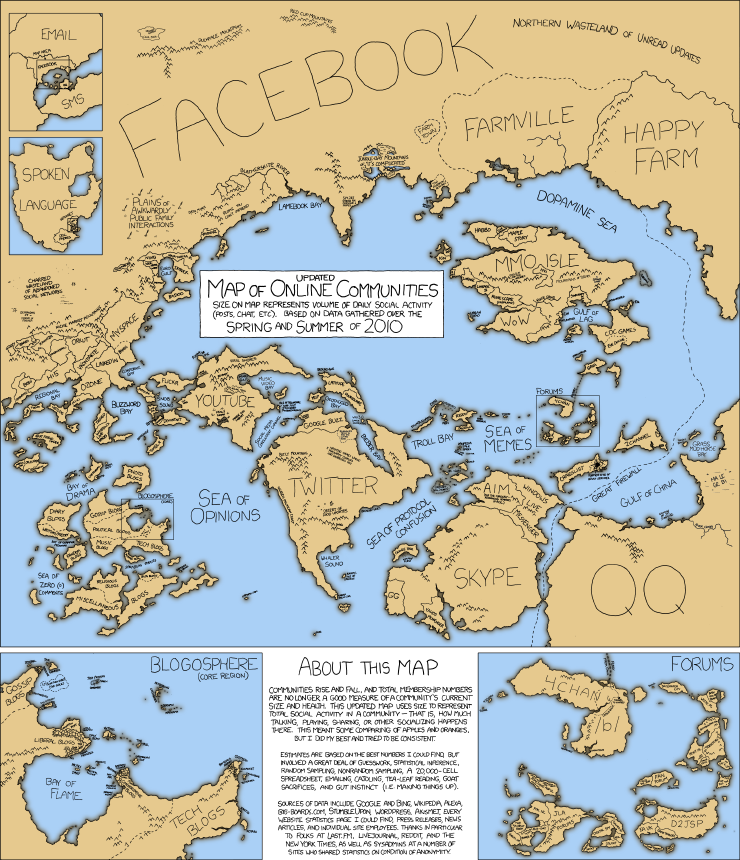
...lead to this (the Points of Control map (August 2010) that formed the starting point for the Web 2.0 summit, discussed by John Battelle and Tim O'Reilly here)?

Admittedly the scope of Points of Control is broader. John Battelle blogs a little about its development here (citing its Risk, Tolkien and, yes, also (indirectly) xkcd). Slides and videos from the summit are here.
17 November 2010
Misleading visualisation

10 November 2010
The power of speed

08 November 2010
Social media and political upheaval
I was prompted by this comment from political scientist, Henry Farrell ...
"I’ll confess to being particularly annoyed by the Gladwell piece because it seems like the purest possible distillation of the intellectual-debate-through-duelling-anecdotes that has plagued discussion over the Internet and authoritarian regimes over the last few years."
...to read the New Yorker article by that sparked it. And I don't find it so contentious. Indeed Farrell concedes that the thrust of Gladwell's argument is not necessarily wrong: that the weakly-linked, politically-motivated internet networks that are so easy to join are unlikely to be a force for change compared to the strongly-linked, disciplined, structured (and hierarchical) political movements that have provoked change in the past (in civil rights, resisting authoritarian regimes and so on). What is contentious, though, is that the article stops short of considering whether or how joining a network and becoming informed about issues leads into commitment to more organised political movements and action (or, indeed, commitment to any other sort of behaviour change, not necessarily political). Farrell points out that we simply don't have the research to know whether the network has any impact here. Gladwell makes, for me, the somewhat unrelated comparison between weakly-linked and strongly-linked political movements and the discrete structures used for different purposes by car manufacturers: networks to sell; hierarchies to design, suggesting there can be no transition between the two. So I see Farrell's frustration.
[Farrell comment via Ethan Zuckerman]
"I’ll confess to being particularly annoyed by the Gladwell piece because it seems like the purest possible distillation of the intellectual-debate-through-duelling-anecdotes that has plagued discussion over the Internet and authoritarian regimes over the last few years."
...to read the New Yorker article by that sparked it. And I don't find it so contentious. Indeed Farrell concedes that the thrust of Gladwell's argument is not necessarily wrong: that the weakly-linked, politically-motivated internet networks that are so easy to join are unlikely to be a force for change compared to the strongly-linked, disciplined, structured (and hierarchical) political movements that have provoked change in the past (in civil rights, resisting authoritarian regimes and so on). What is contentious, though, is that the article stops short of considering whether or how joining a network and becoming informed about issues leads into commitment to more organised political movements and action (or, indeed, commitment to any other sort of behaviour change, not necessarily political). Farrell points out that we simply don't have the research to know whether the network has any impact here. Gladwell makes, for me, the somewhat unrelated comparison between weakly-linked and strongly-linked political movements and the discrete structures used for different purposes by car manufacturers: networks to sell; hierarchies to design, suggesting there can be no transition between the two. So I see Farrell's frustration.
[Farrell comment via Ethan Zuckerman]
01 November 2010
Facebook's posting strategies
It's no surprise that Facebook isn't interested in your news but in how long your readers will look at your updates (photos encourage enlarging and studying the picture), or whether they'll link from them. So that's what Facebook prioritises in your updates to friends' newsfeeds. The Daily Beast reverse engineered Facebook's strategies through a month's study to work this out. They sent the heuristics they discovered to Facebook for comment but, no surprise again, no reply.
[via John Naughton]
[via John Naughton]
16 October 2010
Mapping mobile phone use and epidemics
New Scientist reports on the analysis of communication patterns to map group behaviours; research by Anmol Madan at MIT on how mobile phone communication patterns among students indicate outbreaks of flu (the communication 'symptoms' being fewer calls earlier in the morning and late at night).
I've posted here on the possibilities for misinterpretations of communications patterns. New Scientist also picks up on this problem, citing research by Nathan Eagle (also at MIT) whose research in Rwanda has found similar communications patterns (reduction in movement of phone users) at the outbreak of cholera and the onset of floods.
I've posted here on the possibilities for misinterpretations of communications patterns. New Scientist also picks up on this problem, citing research by Nathan Eagle (also at MIT) whose research in Rwanda has found similar communications patterns (reduction in movement of phone users) at the outbreak of cholera and the onset of floods.
07 October 2010
Noel Coward on Facebook
Discussing his personal use of Facebook, Quentin Stafford-Fraser alludes to a comment on television attributed to Noel Coward:
"...television is for appearing on - not for looking at".
"...television is for appearing on - not for looking at".
20 September 2010
07 September 2010
Trust in web sites
Technology Review summarises some research looking at factors that encourage people to divulge personal information on web sites. It's a mixed picture, with research by Alessandro Acquisti at CMU suggesting that the more formal a web site appears, the less likely people are to give personal information. Joseph Bonneau at Cambridge has found that sites that bury privacy settings (i.e. keeping it off users' minds) are likely to get more information from their users (coincidentally, this research was published just as Facebook increased the complexity of its security settings). Tangentially, Soren Preibusch, also at Cambridge, has found that sites which appear to give a high level of privacy can sell products at a higher price than those that don't.
06 September 2010
Commercial analysis of social networks
The Economist describes how patterns of interaction across networks are analysed by companies seeking to find out who are the influencers within networks, i.e. who needs to be retained as a customer, in order to retain their cohort:
"People at the top of the office or social pecking order often receive quick callbacks, do not worry about calling other people late at night and tend to get more calls at times when social events are most often organised, such as Friday afternoons."
It sounds distasteful. The Economist goes on to explain the benefits: similar analyses can be used to track influencers within organisations, both corporate and criminal (it's claimed that network analysis resulted in the capture of Sadam Hussein) and, more speculatively, within unfamiliar cultures:
"... according to Kathleen Carley of Carnegie Mellon University in Pittsburgh. She is developing a societal model of Sudan with a team of about 40 researchers. Foreign aid workers and diplomats frequently stumble in Sudan because they fail to work out which tribal and political leaders they should work with, and how."
Maybe less distasteful, if it's reliable. But one can't help wondering about the potential for false positives.
[via Mindhacks]
"People at the top of the office or social pecking order often receive quick callbacks, do not worry about calling other people late at night and tend to get more calls at times when social events are most often organised, such as Friday afternoons."
It sounds distasteful. The Economist goes on to explain the benefits: similar analyses can be used to track influencers within organisations, both corporate and criminal (it's claimed that network analysis resulted in the capture of Sadam Hussein) and, more speculatively, within unfamiliar cultures:
"... according to Kathleen Carley of Carnegie Mellon University in Pittsburgh. She is developing a societal model of Sudan with a team of about 40 researchers. Foreign aid workers and diplomats frequently stumble in Sudan because they fail to work out which tribal and political leaders they should work with, and how."
Maybe less distasteful, if it's reliable. But one can't help wondering about the potential for false positives.
[via Mindhacks]
13 August 2010
The characteristics of Twitter use
Psyblog has put together a list of 10 findings from research on Twitter users' behaviour. Despite describing Twitter, rather nicely, as like being at a party and having several conversations with people at one time, he concludes that Twitter is 'less social' than other social networks, demanding less personal information from users, and exhibiting less reciprocation in followers/following and also in responses to tweets.
One element of this non-reciprocity is the following celebrities have. But they're not the only people with large followings. Others 'earn' their following by tweeting interestingly. Psyblog continues: "Occasionally, though, some manage the trick of being famous and quite interesting, e.g. Stephen Fry". Agreed. (Note Psyblog doesn't mention recent research by HP labs showing that number of followers isn't an index of influence on Twitter; that's determined by how much an individual is retweeted.)
Psyblog also points to the Pulse of the Nation analysis and visualisation of the mood content of 300 million American Tweets, carried out by computer scientists at North Eastern University and Harvard Medical School, which shows, so eloquently, changes in mood with time of day and day of the week.
[Psyblog article via Mindhacks; HP research via ReadWriteWeb]
04 August 2010
Psychologising the iPhone 4 antenna furore
Hm, don't want to add to the millions of pixels that have been spilt on this but Graham Bower at NetImperative analyses how Apple's own marketing (explicitly promoting the new atenna design) and mass commentary on the web (focusing on the specifics of loss of reception) worked together to create a storm. Despite Bower's invocation of groupthink, nocebo effect and availability heuristic I think Apple will survive.
[via Usability News]
[via Usability News]
Subscribe to:
Posts (Atom)

 Posts
Posts

