The more effort made to personalise a communication, the more likely it is to be read. Laurent Haug, founder of the Lift conference notes that longer and more personal communications receive more comment.
"For a long time, the Lift page [on Facebook] was managed manually. I would replicate each article carefully, adding a custom message different from the title of the news I was pushing to the community. As soon as we installed an automatic app (RSS graffiti) to republish articles automatically, the number of interactions almost halved."
Haug concludes that social technologies will never be magical. Surprise...or maybe just not magical enough, yet.
[via Alex Soojung-Kim Pang]
Showing posts with label Blogging. Show all posts
Showing posts with label Blogging. Show all posts

12 June 2011
Social media in academia
Starting with the premise that other information enterprises (news, book-selling, music) have seen changes with the rise of social media, and asking what will lies ahead for academic life, a Berkman Center panel brings together four Harvard professors, long-standing users of social media, to describe what social media they use and how (more blogging than tweeting, to be honest). There is a heartwarming, albeit somewhat edited, clip of a three way video seminar between US, Chinese and Japanese students, following the Fukushima disaster, and some interesting reflections on the lack of serious challenge so far to the grip traditional publishers still have on academic libraries. Not enough of the post-panel discussion on the video, though. Could we have the technology to eavesdrop on that, too?
[via John Naughton]
15 October 2010
Police PR on Twitter

07 October 2010
Noel Coward on Facebook
Discussing his personal use of Facebook, Quentin Stafford-Fraser alludes to a comment on television attributed to Noel Coward:
"...television is for appearing on - not for looking at".
"...television is for appearing on - not for looking at".
26 August 2010
Focus in lifelogging and blogging
I recently read Sellen and Whittaker's excellent review of Lifelogging studies. Their key point is that, so far, prototypes haven't capitalised on what we know of how human memory works, for example
- that we store partial, associatively organised memories of events, rather than total, chronological capture- that although we want to recall things, we also want to reminisce, and reflect on our memories
- and that one of our challenges is not remembering things from the past, but remembering to do things in the future.
Some interesting details emerge (for example, Gregory Abowd's finding that lecture recordings don't significantly improve students' grades; that whereas trials show meeting recording is popular with participants, it has never caught on as a business tool).
Sellen and Whittaker make the distinction between passive 'lifelogging' and active 'blogging' in which we choose what aspects of our lives to record, one of which is, apparently, food. TechCrunch post on recent funding for food blogging service, Foodspotting, commenting 'Don’t even bother arguing about it. It’s just the way it is'.
And so it would seem: in yesterday's Guardian Martin Parr was encouraging readers to photograph their food:
"When you are away, why not record all of the food that you eat? If someone has spent a lot of time cooking a meal, or if you're going out for a treat, photograph the food. You could make a series of each breakfast, lunch and dinner that you ate. That would be fascinating."
Indeed.
- that we store partial, associatively organised memories of events, rather than total, chronological capture- that although we want to recall things, we also want to reminisce, and reflect on our memories
- and that one of our challenges is not remembering things from the past, but remembering to do things in the future.
Some interesting details emerge (for example, Gregory Abowd's finding that lecture recordings don't significantly improve students' grades; that whereas trials show meeting recording is popular with participants, it has never caught on as a business tool).
Sellen and Whittaker make the distinction between passive 'lifelogging' and active 'blogging' in which we choose what aspects of our lives to record, one of which is, apparently, food. TechCrunch post on recent funding for food blogging service, Foodspotting, commenting 'Don’t even bother arguing about it. It’s just the way it is'.
And so it would seem: in yesterday's Guardian Martin Parr was encouraging readers to photograph their food:
"When you are away, why not record all of the food that you eat? If someone has spent a lot of time cooking a meal, or if you're going out for a treat, photograph the food. You could make a series of each breakfast, lunch and dinner that you ate. That would be fascinating."
Indeed.
13 August 2010
The characteristics of Twitter use
Psyblog has put together a list of 10 findings from research on Twitter users' behaviour. Despite describing Twitter, rather nicely, as like being at a party and having several conversations with people at one time, he concludes that Twitter is 'less social' than other social networks, demanding less personal information from users, and exhibiting less reciprocation in followers/following and also in responses to tweets.
One element of this non-reciprocity is the following celebrities have. But they're not the only people with large followings. Others 'earn' their following by tweeting interestingly. Psyblog continues: "Occasionally, though, some manage the trick of being famous and quite interesting, e.g. Stephen Fry". Agreed. (Note Psyblog doesn't mention recent research by HP labs showing that number of followers isn't an index of influence on Twitter; that's determined by how much an individual is retweeted.)
Psyblog also points to the Pulse of the Nation analysis and visualisation of the mood content of 300 million American Tweets, carried out by computer scientists at North Eastern University and Harvard Medical School, which shows, so eloquently, changes in mood with time of day and day of the week.
[Psyblog article via Mindhacks; HP research via ReadWriteWeb]
04 July 2010
Cory Doctorow's technology
I love this post by Cory Doctorow, detailing his current technology suite. Why? I suppose the user researcher in me is always going to be intrigued by people's choices, their work processes, the person behind the public persona etc., but it's probably more neurosis about the decisions I've made.
I'll take some tips, and also some reassurance on a couple of things e.g. my attachment (still) to email. Regarding the blog trawling I currently do by cycling through a series of tabs (which I think is really inefficient), Cory does it too. Erm, but with a slight difference in quantity (and, not suprisingly, quality of results):
"I have a couple hundred sites in a folder that I open as a series of tabs a couple times a day, quickly zipping through them after they’ve loaded to see if anything new has been posted."
Wow.
[via BoingBoing]
I'll take some tips, and also some reassurance on a couple of things e.g. my attachment (still) to email. Regarding the blog trawling I currently do by cycling through a series of tabs (which I think is really inefficient), Cory does it too. Erm, but with a slight difference in quantity (and, not suprisingly, quality of results):
"I have a couple hundred sites in a folder that I open as a series of tabs a couple times a day, quickly zipping through them after they’ve loaded to see if anything new has been posted."
Wow.
[via BoingBoing]
02 July 2010
The perils of voice input
Having worked on a voice input study recently, I cannot resist this.
Interestingly Wordpress is now supporting posting voice clips via phone. According to Mashable, LiveJournal has supported similar function for years. Would be interesting to know what uptake is.
[Bournistoun clip via Olly Bayley]
22 June 2010
iPad's impact on productivity
John Naughton is road-testing an iPad and comments on how its 'one-app-at-a-time' interface limits productivity when writing his blog. A fluid interaction on 'a real computer', of selecting a source, highlighting it and pulling it into Wordpress for publication now becomes a very clunky sequence of opening applications, cutting and pasting etc. As Naughton comments, the experience highlights Apple's focus on the iPad as a tool for consumption.
07 April 2010
The power of a picture
Futurelab reports data from HubSpot that Twitter accounts bearing a picture of the tweeter are ten times more likely to be followed than accounts that don't. Taking into account the likelihood that accounts with a picture are more active than those without, which probably exerts a large effect, the data back a hunch I have about the importance of attaching pictures to biographies on organisational websites. Someone who looks at biographies wants to know about the people behind the machine and lack of pictures deprives them of valuable information.
And on blogs?
And on blogs?
12 March 2010
On the origins of blog topics
This week, Georgina Henry, celebrates the four year anniversary of The Guardian's Comment is Free where readers respond to Guardian opinion pieces and authors (sometimes) engage with comments in a group blog. Henry describes the Cif community as its 'lifeblood' and describes how 'Cif editors look to our community for inspiration. We ask them what they want to discuss, debate and argue about; to recommend writers...to suggest comment elsewhere which we should link to.' This is a step towards the kind of journalism Jeff Jarvis seeks.
Cif isn't perfect (see Bob Geldof's rant in response to Rageh Omaar's measured comments on the recent World Service/Ethiopian aid controversy - but, in that case, what would you expect). But consider the contrast with an experiment run by IBM where, having discovered that most company bloggers trail off into silence after a relatively short period of time, they developed "Blog Muse" which suggested reader-generated blog topics that might stimulate their bloggers to write. Its impact? Pretty limited in its power to generate more blog posts. But there were some interesting findings: topics with more reader suggestions tended to be more attractive to bloggers than those with fewer, and to receive more reader comments.
I wonder how much they've unpicked that. Setting aside the simple possibility that these topics are more central to employees' concerns it reminded me of the Cabinet Office's recent publication, Mindspace, on influencing behaviour through public policy, where the 'e' in the Mindspace acronym is for 'ego'. According to the behavioural economists behind Mindspace, policy interventions intended to influence behaviour should appeal to the egos of the people who are targets of the intervention. So you can see why, in a corporate environment, a blogger might want to respond to topics with a high number of reader suggestions, and readers to comment on them. The high level of commenting then provides an incentive to continue following popular topics ('incentive' is the 'i' in Mindspace) so a system of group-driven thinking develops. Perhaps not the outcome IBM intended.
["Blog Muse" link via John Naughton]
Cif isn't perfect (see Bob Geldof's rant in response to Rageh Omaar's measured comments on the recent World Service/Ethiopian aid controversy - but, in that case, what would you expect). But consider the contrast with an experiment run by IBM where, having discovered that most company bloggers trail off into silence after a relatively short period of time, they developed "Blog Muse" which suggested reader-generated blog topics that might stimulate their bloggers to write. Its impact? Pretty limited in its power to generate more blog posts. But there were some interesting findings: topics with more reader suggestions tended to be more attractive to bloggers than those with fewer, and to receive more reader comments.
I wonder how much they've unpicked that. Setting aside the simple possibility that these topics are more central to employees' concerns it reminded me of the Cabinet Office's recent publication, Mindspace, on influencing behaviour through public policy, where the 'e' in the Mindspace acronym is for 'ego'. According to the behavioural economists behind Mindspace, policy interventions intended to influence behaviour should appeal to the egos of the people who are targets of the intervention. So you can see why, in a corporate environment, a blogger might want to respond to topics with a high number of reader suggestions, and readers to comment on them. The high level of commenting then provides an incentive to continue following popular topics ('incentive' is the 'i' in Mindspace) so a system of group-driven thinking develops. Perhaps not the outcome IBM intended.
["Blog Muse" link via John Naughton]
01 January 2010
Using social media
"I never had a blog (I find it much more effective to write for BusinessWeek and TechCrunch)...'
...throwaway by Vivek Wadhwa (who he) in a piece for Techcrunch on his use of Twitter.
Elsewhere ReadWriteWeb counsel on when not to use social media.
...throwaway by Vivek Wadhwa (who he) in a piece for Techcrunch on his use of Twitter.
Elsewhere ReadWriteWeb counsel on when not to use social media.
07 November 2009
Tweeting and blogging
How many more Twitter and... posts, I wonder?
Jeff Jarvis is worrying that as he is tweeting more, he is blogging less, and so failing to develop ideas (or have them developed through comments) into something more enduring than a passing thought. He thinks Twitter may lead to wwa or, if not world wide amnesia, to his at least. Liz Lawley comments that as far back (!) as 2003 she lamented the transience of topics in blog posts. I suppose this might be caricatured as the academic's counter to the journalist's (now academic) point of view. But even if individual posts are transient, the organisational and archival possibilities of blogs makes them (for me) more powerful than tweet streams. Link in a tweet stream. Then what? Remember it? Probably not. You have to do some more processing, even if it's just tagging it, to make it your own. At least tagged posts can be retrieved again without sequential scrolling. Twitter needs more organisational tools if it's to have any durability. And then you wonder whether that misses the point. Do 140-character, impromptu posts really merit such organisation.
Anyway, much as Stephen Fry has not stopped tweeting, so Jeff Jarvis hasn't stopped blogging, with a lovely post yesterday proposing a Gadget of the Month Club to enable cash-strapped geeks to try out new tech as soon as it comes to market. Great idea, although as some comments point out it sits uncomfortably with manufacturer/operator lock ins. You'd have to repeat synch your data (with the risk that synching wouldn't always be complete) or carry around an up-to-date SIM, assuming it would be accessible from all devices.
(As an aside, having linked to Liz Lawley's blog for this post I came across her account of Westin hotels (Seattle, of course) making amazingly smooth use of Twitter to engage with customers.)
Jeff Jarvis is worrying that as he is tweeting more, he is blogging less, and so failing to develop ideas (or have them developed through comments) into something more enduring than a passing thought. He thinks Twitter may lead to wwa or, if not world wide amnesia, to his at least. Liz Lawley comments that as far back (!) as 2003 she lamented the transience of topics in blog posts. I suppose this might be caricatured as the academic's counter to the journalist's (now academic) point of view. But even if individual posts are transient, the organisational and archival possibilities of blogs makes them (for me) more powerful than tweet streams. Link in a tweet stream. Then what? Remember it? Probably not. You have to do some more processing, even if it's just tagging it, to make it your own. At least tagged posts can be retrieved again without sequential scrolling. Twitter needs more organisational tools if it's to have any durability. And then you wonder whether that misses the point. Do 140-character, impromptu posts really merit such organisation.
Anyway, much as Stephen Fry has not stopped tweeting, so Jeff Jarvis hasn't stopped blogging, with a lovely post yesterday proposing a Gadget of the Month Club to enable cash-strapped geeks to try out new tech as soon as it comes to market. Great idea, although as some comments point out it sits uncomfortably with manufacturer/operator lock ins. You'd have to repeat synch your data (with the risk that synching wouldn't always be complete) or carry around an up-to-date SIM, assuming it would be accessible from all devices.
(As an aside, having linked to Liz Lawley's blog for this post I came across her account of Westin hotels (Seattle, of course) making amazingly smooth use of Twitter to engage with customers.)
15 September 2009
Blogger's 10th anniversary
Celebrated this month. Here's John Naughton's affectionate Observer column on blogging's success, against predictions. As John says, all human life is here, often to be stumbled across by chance. One of the most unexpected (but charming) I've run into recently (whilst searching for a recipe) was Pioneer Woman.
29 May 2009
CVs that stand out
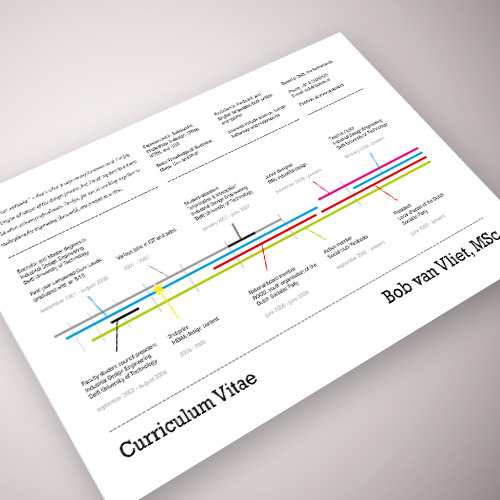
In response to a query on Brighton New Media List, someone pointed to this innovative approach to CV design from Delft graduate, Bob van Vliet. His approach to blog format is interesting too.
27 May 2009
Work and life
John Naughton quotes a delightful (1959) essay by C. Wright Mills, "On Intellectual Craftmanship" in which he (Naughton) sees the origins of blogging. Included is this paragraph:
“set up a file, which is, I suppose, a sociologist’s way of saying: - keep a journal. Many creative writers keep journals; the sociologist’s need for systematic reflection demands it. In such a file as I am going to describe, there is joined personal experience and professional activities, studies under way and studies planned. In this file, you, as an intellectual craftsman, will try to get together what you are doing intellectually and what you are experiencing as a person. Here you will not be afraid to use your experience and relate it directly to various work in progress. By serving as a check on repetitious work, your file also enables you to conserve your energy. It also encourages you to capture “fringe-thoughts”: various ideas which may be by-products of everyday life, snatches of conversation overheard on the street, or, for that matter, dreams. Once noted, these may lead to more systematic thinking, as well as lend intellectual relevance to more directed experience.”
Yes, that's about it.
Elsewhere the paper talks about the need to combine work and life (i.e. not create boundaries between the two). I know very few people who don't combine the two, all lucky enough to be working in what you might loosely call intellectual or creative professions. I wonder whether their 'life' (in the form of their family) really appreciates or benefits from this fusion.
“set up a file, which is, I suppose, a sociologist’s way of saying: - keep a journal. Many creative writers keep journals; the sociologist’s need for systematic reflection demands it. In such a file as I am going to describe, there is joined personal experience and professional activities, studies under way and studies planned. In this file, you, as an intellectual craftsman, will try to get together what you are doing intellectually and what you are experiencing as a person. Here you will not be afraid to use your experience and relate it directly to various work in progress. By serving as a check on repetitious work, your file also enables you to conserve your energy. It also encourages you to capture “fringe-thoughts”: various ideas which may be by-products of everyday life, snatches of conversation overheard on the street, or, for that matter, dreams. Once noted, these may lead to more systematic thinking, as well as lend intellectual relevance to more directed experience.”
Yes, that's about it.
Elsewhere the paper talks about the need to combine work and life (i.e. not create boundaries between the two). I know very few people who don't combine the two, all lucky enough to be working in what you might loosely call intellectual or creative professions. I wonder whether their 'life' (in the form of their family) really appreciates or benefits from this fusion.
11 March 2009
Everyday story of using a feed reader
I liked this account by Dr Shock, of how he filters information for his blog. I especially liked the quote: In der Beschränkung zeigt sich erst der Meister (it is only in being able to pare down that the master is revealed).
19 February 2009
Books as objects
Jeff Jarvis holds his hands up to accusations of hypocrisy for publishing What Would Google Do as a conventional book. His defenders remind us that most of the book's content has also appeared for free on Jarvis's blog. Jarvis defends himself along the lines of "a dog has to eat."
But it's not just a financial thing. However influential Jarvis's blog has become, a book does many things a blog doesn't (yet): it tells us a publisher is prepared to invest in the author; it allows us relaxed reading in almost any context (without battery power); we can annotate it; we can display it, to say something about us; we can pass it on as a gift to friends. These long-established practicalities and values don't yet translate to Jarvis's new Google world.
As an aside Jarvis comments that he wishes a reader could buy the book in all media (paper, e-book, iPhone) all with one fee. Absolutely! And purpose designed in each medium, too, please.
But it's not just a financial thing. However influential Jarvis's blog has become, a book does many things a blog doesn't (yet): it tells us a publisher is prepared to invest in the author; it allows us relaxed reading in almost any context (without battery power); we can annotate it; we can display it, to say something about us; we can pass it on as a gift to friends. These long-established practicalities and values don't yet translate to Jarvis's new Google world.
As an aside Jarvis comments that he wishes a reader could buy the book in all media (paper, e-book, iPhone) all with one fee. Absolutely! And purpose designed in each medium, too, please.
24 January 2009
User-involvement via the web
This week* Jeff Jarvis commented on the design collaboration between Buglabs and IDEO, where a design blog is being used to capture user input, convey concepts and gather feedback. This extends the user forum approach that Dell (and others) have used. (In Dell's case their IdeaStorm resulted in specific design features being included in the Latitude.)**
The comments on Jarvis's post are critical of his proposal that the Buglabs/IDEO approach could be useful in automative design: apparently Local Motors have already used a similar technique in automative design) so his proposal is not new; furthermore, the Pontiac Aztek, which was designed with substantial focus group input was subsequently hammered by critics and out of production after three years. I'm sure IDEO are fully aware of the methodological limitations of the blog, but I think this method does have its place, particularly for a project where most contributors are likely to be at ease with blogging and blog etiquette.
The blog itself is a pleasure to read and great publicity for both partners in the process. Thinking of Liz Sanders' design research map, which I've commented on previously, I'd put this method somewhere above 'Lead user innovation,' just in her Design-led/Participatory quadrant.
* I realise that other hugely important things also happened this week - and the user/technology story from that (X-box to Atari) has been covered elsewhere
** David Gelles' FT article 'The new corporate firefighters' (22 January) covered the role of social media in maintaining communication with customers.
The comments on Jarvis's post are critical of his proposal that the Buglabs/IDEO approach could be useful in automative design: apparently Local Motors have already used a similar technique in automative design) so his proposal is not new; furthermore, the Pontiac Aztek, which was designed with substantial focus group input was subsequently hammered by critics and out of production after three years. I'm sure IDEO are fully aware of the methodological limitations of the blog, but I think this method does have its place, particularly for a project where most contributors are likely to be at ease with blogging and blog etiquette.
The blog itself is a pleasure to read and great publicity for both partners in the process. Thinking of Liz Sanders' design research map, which I've commented on previously, I'd put this method somewhere above 'Lead user innovation,' just in her Design-led/Participatory quadrant.
* I realise that other hugely important things also happened this week - and the user/technology story from that (X-box to Atari) has been covered elsewhere
** David Gelles' FT article 'The new corporate firefighters' (22 January) covered the role of social media in maintaining communication with customers.
04 December 2008
The decline of blogging
By coincidence, at the point I was thinking I must make more use of my blog Nicholas Carr was writing on blogging's decline, citing studies showing the shift from personal to professional or corporate blogs, in effect on-line magazines (reference via John Naughton's blog). Since I have a very specific purpose in this blog I suppose I don't mind his comparison of blogging and amateur radio. Now where's that hand-knitted waistcoat I once had....
Subscribe to:
Posts (Atom)

 Posts
Posts

