Nice pop explanation at Salon of the need for quality, spaced practice, not just massed practice. This is one of my favourite, non-intuitive and robust psychological phenomena, first demonstrated in the late 19th century (by Ebbinghaus) and replicated in multiple studies subsequently.
[via Katja Battarbee]
Showing posts with label Thinking methods. Show all posts
Showing posts with label Thinking methods. Show all posts
22 April 2014

04 April 2014
Extravagant claims for big data
Concise review by Tim Harford of the promise of big data and how it can go awry, citing inaccuracies that emerged in the celebrated Google Flu Trends, possibly because Google's own search engines may have been prompting searches, even when the searcher's own symptoms didn't suggest flu. According to an analysis in Science, in 2013 this led to an over-estimate that almost doubled the actual data on the incidence of flu. Harford also covers the problem of multiple comparisons which can yield patterns that, although significant, are spurious. While comparisons that fail to show effects remain in the desk drawer.
Related, but not quite: xkcd's 'little data' representation, Frequency.

Related, but not quite: xkcd's 'little data' representation, Frequency.
12 June 2013
The impact of introspection on preference choices
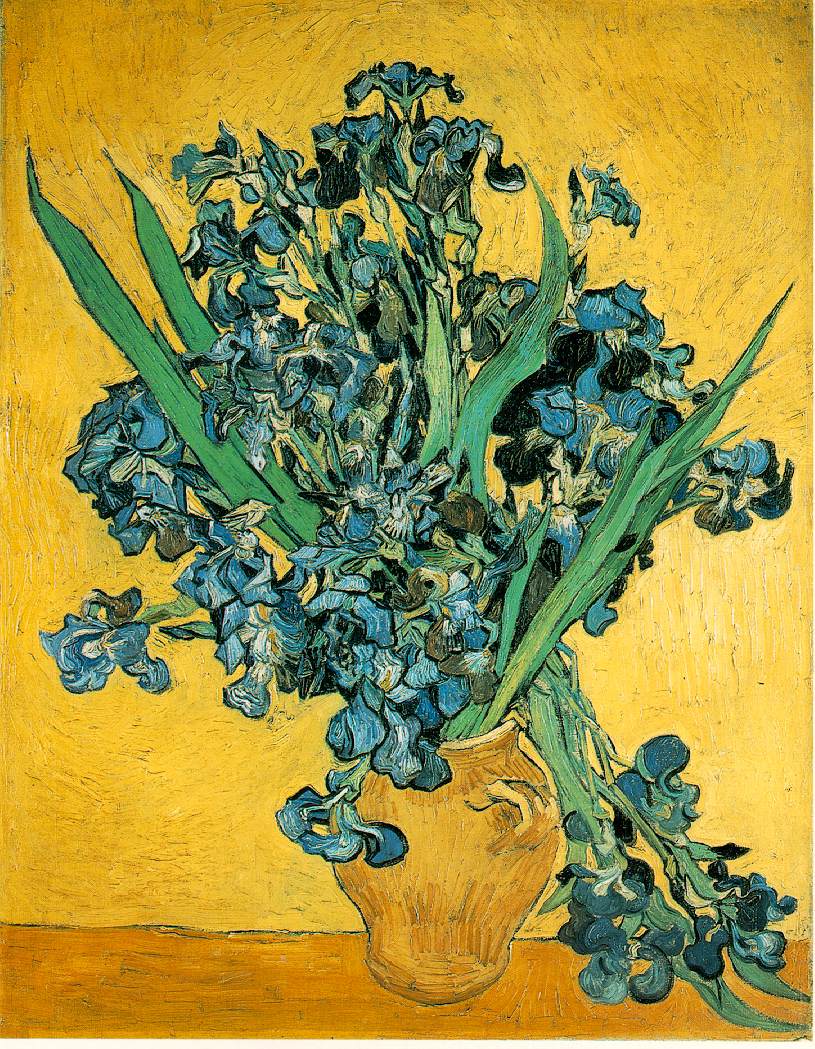 |
| Van Gogh's Irises, from the Rijksmuseum, Amsterdam |
Worth bearing in mind when carrying out studies of visual attributes, as I so often do, that require participants to explain their preferences and choices.
[via Mindhacks]
23 July 2012
Sontag on aphorisms
Maria Popova at Brainpickings brings together some of Susan Sontag's thoughts on aphorisms, which she (Sontag) describes as impatient thinking. I liked Sontag's characterisation of typical aphoristic subject matter:
the hypocrisies of societies, the vanities of human wishes, the shallowness + deviousness of women; the sham of love; the pleasures (and necessity) of solitude; + the intricacies of one’s own thought processes.
John Naughton cites Auden and Kronenberger as counter-evidence. Maybe the exception that proves the rule, or just a complete non-alignment of two very different perspectives.
the hypocrisies of societies, the vanities of human wishes, the shallowness + deviousness of women; the sham of love; the pleasures (and necessity) of solitude; + the intricacies of one’s own thought processes.
John Naughton cites Auden and Kronenberger as counter-evidence. Maybe the exception that proves the rule, or just a complete non-alignment of two very different perspectives.
22 February 2012
More on brainstorming
 |
| MIT Building 20 |
Lehrer's article includes a lengthy description of Building 20 at MIT (pictured above), a legendarily uncomfortable but equally legendarily productive, temporary structure, that housed and serendipitously brought together a wide ranging group of scientists and technologists (including, incidentally, Noam Chomsky and Amar Bose). I work in a 1940s temporary structure (originally a prosthesis centre for injured WW2 airmen), with all that that entails for comfort, at least in Winter. I will keep Building 20 in mind.
15 January 2012
Periodic table of visualisation techniques
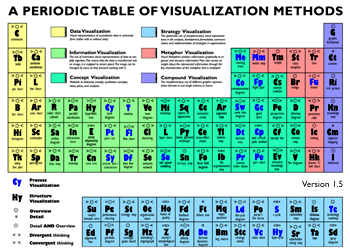
Here. Lots of clever detail. Read more from its creators, Ralph Lengler and Martin Eppler, publishing in 2007, here.
[Via Jack Schofield from Visual literacy.org]
16 November 2011
04 November 2011
On asking dumb questions
"I often feel like a halfwit, sure, but I also get to make amazing discoveries."
Science writer, Cassandra Willyard, describes the chagrin she felt when she discovered, 15 years after its launch, that the Hubble Telescope was in space. Having been brought up near Jodrell Bank my mental image of a telescope is always something grounded and cup shaped, so I can understand her assumption. Her point is how much knowledge can be gained from having the confidence to ask 'dumb' questions.
[via NotExactlyRocketScience]
Science writer, Cassandra Willyard, describes the chagrin she felt when she discovered, 15 years after its launch, that the Hubble Telescope was in space. Having been brought up near Jodrell Bank my mental image of a telescope is always something grounded and cup shaped, so I can understand her assumption. Her point is how much knowledge can be gained from having the confidence to ask 'dumb' questions.
[via NotExactlyRocketScience]
13 September 2011
Tracking paths through the web
Clive Thompson worries that he loses the paths that get him to information on the web and, in so doing, loses 'cognitive value'. Personally, I'm not sure how much value is lost in a string of un-processed links. Usually there's a way back to things you've skimmed. On the other hand I like the idea of tracking (with their agreement) other people's paths, with their agreement, as in reading.am.
[via Cory Doctorow]
[via Cory Doctorow]
05 September 2011
Explaining left and right

[Via NotExactlyRocketScience]
18 July 2011
Search alters memory
Apparently, according to research by Betsy Sparrow at Columbia University and reported by Wired, Ed Yong and in many other places. Using a Stroop test Sparrow found that, when presented with questions that were difficult to answer, students tended to think of computers (i.e. took longer to name colours used for words such as 'Google, browser or computer' than for words less connected with computers).
In a different study, Sparrow asked students to type out a set of unrelated trivia statements and found that those students who had been told the statements would be stored on a computer remembered less of the detail of those statements than those told that the statements would be deleted. Sparrow hypothesises that people use computers as a source of transactive memory - i.e. like a member of a social group who can be relied upon to remember detailed information. Sparrow tested this further in a study where, following typing a trivia statement, students were told the statement would be deleted, or stored in a specific folder. Students remembered more of the statements they had been told would be deleted than those they had been told would be saved, but their memory for the locations that the statements had been saved to was, however, rather good.
Everyone is at pains to say that memory is not getting worse because of computers, just different. Sparrow suggests that human memory is adapting to the tools available, remembering where information is, rather than its content. Yong comments that as location (i.e. specific folder information) becomes less significant in systems that enable search across all kinds of locations, remembering the key words used for searches may become more important than remembering file locations.
In a different study, Sparrow asked students to type out a set of unrelated trivia statements and found that those students who had been told the statements would be stored on a computer remembered less of the detail of those statements than those told that the statements would be deleted. Sparrow hypothesises that people use computers as a source of transactive memory - i.e. like a member of a social group who can be relied upon to remember detailed information. Sparrow tested this further in a study where, following typing a trivia statement, students were told the statement would be deleted, or stored in a specific folder. Students remembered more of the statements they had been told would be deleted than those they had been told would be saved, but their memory for the locations that the statements had been saved to was, however, rather good.
Everyone is at pains to say that memory is not getting worse because of computers, just different. Sparrow suggests that human memory is adapting to the tools available, remembering where information is, rather than its content. Yong comments that as location (i.e. specific folder information) becomes less significant in systems that enable search across all kinds of locations, remembering the key words used for searches may become more important than remembering file locations.
19 June 2011
Newspaper health advice
Ben Goldacre reports his analysis (with colleagues, Cooper, Lee and Sanders) of the accuracy of dietary advice in newspapers, taking a random sample of the content of newspapers published over a week. Of 111 health claims over the period, 62% were supported by evidence classified as 'insufficient', 10% were 'possible', 12% were 'probable', leaving only 15% in which the evidence was 'convincing'. There were fewer low quality claims ('insufficient' or 'possible') in broadsheets, but as Goldacre puts it, 'there wasn't much in it'.
18 May 2011
Tufte: Information Sage
Substantial Washington Monthly article, with some interesting comments, on Edward Tufte. The article includes a little scepticism from Don Norman (and riposte from Tufte). Comments suggest that, notwithstanding Tufte's intellect and impact, the principles are fine but implementing them not always so easy.
[via InfoDesign]
[via InfoDesign]
03 May 2011
Cognitive dissonance and environmental behaviour
Another piece of research (see, also) showing that people's initial mindset is likely to influence their response to information about their carbon consumption. Research by Amara Brook found that students who were initially unsympathetic to environmental information, given (false) feedback indicating that their carbon footprint was high, were likely to become less sympathetic to environmental issues, unlike students who were initially conscious of environmental issues. Brook suggests this is the effect of resolving cognitive dissonance: adapting thinking so it is consistent with evident behaviour. Her proposed solution is giving people simple information about the steps to take to reduce consumption. Maybe. Of course often students don't pay all their costs, so it would be interesting to see if the finding transferred to older consumers.
[via BPS Research Digest]
[via BPS Research Digest]
26 March 2011
Information overload - again
More here on Ann Blair's book Too Much to Know: Managing Scholarly Information Before the Modern Age, which I've written about here. This time quoting Seneca: "the abundance of books is distraction".
[via John Naughton]
[via John Naughton]
19 January 2011
Cognitive tools for life
Edge asked 'what scientific concept would improve everybody's cognitive toolkit?'. 164 contributed, some whimsically. I liked Stephen Kosslyn's, 'much creativity emerges from constraint satisfaction'.
[via MindHacks]
[via MindHacks]
07 January 2011
The psychology of climate change communication

[via NotExactlyRocketScience]
08 December 2010
Digital media (potentially) making us smart
"The basic plan of the brain's "wiring" is determined by genetic programs and biochemical interactions that do most of their work long before a child discovers Facebook and Twitter. There is simply no experimental evidence to show that living with new technologies fundamentally changes brain organization in a way that affects one's ability to focus. Of course, the brain changes any time we form a memory or learn a new skill, but new skills build on our existing capacities without fundamentally changing them. We will no more lose our ability to pay attention than we will lose our ability to listen, see or speak."
From LA Times article by Christopher Chabris and Daniel Simons. They argue that 'the human-computer-Internet collective' is far smarter than the individual alone, although there is danger in that easy access to knowledge can fool us in believing we already have that knowledge and understand more than we do.
[via Alex Pang (who will be working with Microsoft on interfaces for sustained concentration)]
From LA Times article by Christopher Chabris and Daniel Simons. They argue that 'the human-computer-Internet collective' is far smarter than the individual alone, although there is danger in that easy access to knowledge can fool us in believing we already have that knowledge and understand more than we do.
[via Alex Pang (who will be working with Microsoft on interfaces for sustained concentration)]
Peer influence and behaviour change - a wrinkle
The idea that people's motivation to change their behaviour (e.g. in energy consumption) will be boosted by knowing norms for others similar to them gets a bit of a knock from research on electricity consumption in California. Dora Costa and Matthew Kahn have found that while nudging people with norm data reduces consumption by roughly 2 per cent, this isn't evenly distributed across households. It varies according to political leanings: homeowners who identified themselves as Republicans cut consumption by only 0.4 per cent. And those Republicans with no interest in environmental causes increased electricity use by 0.75 per cent.
Clearly one nudge doesn't fit all.
[via PuttingPeopleFirst]
Clearly one nudge doesn't fit all.
[via PuttingPeopleFirst]
01 December 2010
Don Norman and poorly researched design
Don Norman is in typical form here. Taking as his starting point, Kevin McCullagh's comments on the relevance of traditional design skills to many modern design problems, Norman is vexed by the simplistic design solutions to difficult social and environmental problems that often win design awards (awards where, to quote, 'the uninformed judge the uninformed'). He links back from these headline winners to the inadequacies of the design education that led to them. I'm not sure a direct link is fair. Often design firms propose solutions to high-profile, complex problems as PR pieces, usually without the context of working with a client who can help focus design work. On the basis that there's no such thing as bad publicity,* these PR proposals seem to work well, and provide affirmation to the design team which, yes, can then result in naivety or optimism about the problems they can tackle well.
In Norman's eyes, though, the responsibility for the over-confidence these solutions represent lies with design education that fails to teach designers how to research problems and test solutions. He thinks design schools perpetuate a culture that cherry picks superficial research findings, and bends them to its purpose (see Harry Brignull's comments on this tradition). Norman mitigates his criticisms (although I think he's tough enough not to feel any threat) by conceding that design is a different discipline from science and engineering and brings different qualities to product development. He also acknowledges that research in human sciences has its own agenda; not, in many cases, to inform designers.
Many of the issues Norman raises are cultural problems with foundations in the psychology of individuals and teams. I recently gave a talk about working in user experience design to a university research group of artists, designers and psychologists. One of the artists asked why my role was needed since everything I had said about understanding users and testing ideas was so obvious, don't designers do it anyway? As an example I talked about the need to test design solutions and revise them in the light of feedback from people outside the design team, and asked him how he felt when a paper he had written was returned to him for revision, editing etc. Did he ever feel reviewers had misunderstood his intentions, some reluctance to revise? Then imagine those feelings transferred to a team, committed to working on a product or service together together. He began to see what I meant.
*Tangentially, note piece in the NY Times about unscrupulous business, DecorMyEyes, using adverse commentary on the web to drive hits to its site and elevate its ranking in Google searches. Anecdotally, from Google's analytics of this blog, I see that one of the most frequent searches hits my post on IDEO's speculative work on the Bloomberg screen, a project that received as much negative as positive commentary.
[Norman article via InfoDesign; NY Times article via Tim O'Reilly]
In Norman's eyes, though, the responsibility for the over-confidence these solutions represent lies with design education that fails to teach designers how to research problems and test solutions. He thinks design schools perpetuate a culture that cherry picks superficial research findings, and bends them to its purpose (see Harry Brignull's comments on this tradition). Norman mitigates his criticisms (although I think he's tough enough not to feel any threat) by conceding that design is a different discipline from science and engineering and brings different qualities to product development. He also acknowledges that research in human sciences has its own agenda; not, in many cases, to inform designers.
Many of the issues Norman raises are cultural problems with foundations in the psychology of individuals and teams. I recently gave a talk about working in user experience design to a university research group of artists, designers and psychologists. One of the artists asked why my role was needed since everything I had said about understanding users and testing ideas was so obvious, don't designers do it anyway? As an example I talked about the need to test design solutions and revise them in the light of feedback from people outside the design team, and asked him how he felt when a paper he had written was returned to him for revision, editing etc. Did he ever feel reviewers had misunderstood his intentions, some reluctance to revise? Then imagine those feelings transferred to a team, committed to working on a product or service together together. He began to see what I meant.
*Tangentially, note piece in the NY Times about unscrupulous business, DecorMyEyes, using adverse commentary on the web to drive hits to its site and elevate its ranking in Google searches. Anecdotally, from Google's analytics of this blog, I see that one of the most frequent searches hits my post on IDEO's speculative work on the Bloomberg screen, a project that received as much negative as positive commentary.
[Norman article via InfoDesign; NY Times article via Tim O'Reilly]
Subscribe to:
Posts (Atom)

 Posts
Posts

