A little while ago Bill Wessel, of Foviance, blogged on how the iPhone and its successors had changed mobile interaction in a way that couldn't have been envisioned, as recently as 2006. The shift in expectation was brought home to me over the holiday as I tried using a basic Kindle, and found myself constantly wanting to interact directly with the display, and frustrated by the tedious process of navigating a keyboard using a cursor key and select option.
This video shows clever work by Jack Zylkin that turns the whole sequence of progress on its head, with an iPod driven by a typewriter.
[Foviance blog via Usability News; video via John Naughton]
Showing posts with label HCI. Show all posts
Showing posts with label HCI. Show all posts
11 January 2012

28 November 2011
Sketching Apple's first icons

[via Jason Kottke]
10 November 2011
The limits of gestural interfaces
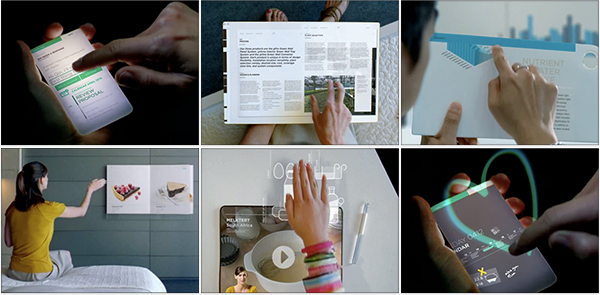
or this?
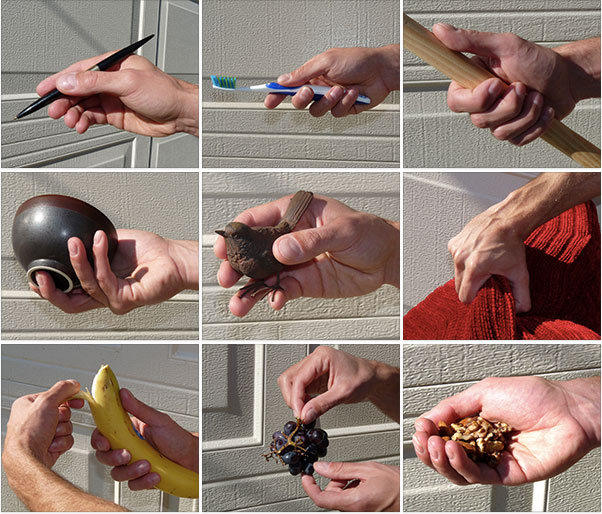
Takes me back to Don Norman's comments on the arbitrary nature of current gestural interfaces.
[via BoingBoing]
06 October 2011
Steve Jobs
Couldn't let the day pass without some comment on Steve Jobs, without whose contribution I and probably many others might still be finding IT awkward but necessary. This quote comes from an interview in Wired in 1996.
What's the biggest surprise this technology will deliver?
The problem is I'm older now, I'm 40 years old, and this stuff doesn't change the world. It really doesn't.
That's going to break people's hearts.
I'm sorry, it's true. Having children really changes your view on these things. We're born, we live for a brief instant, and we die. It's been happening for a long time. Technology is not changing it much - if at all.
These technologies can make life easier, can let us touch people we might not otherwise. You may have a child with a birth defect and be able to get in touch with other parents and support groups, get medical information, the latest experimental drugs. These things can profoundly influence life. I'm not downplaying that. But it's a disservice to constantly put things in this radical new light - that it's going to change everything. Things don't have to change the world to be important.
It's quoted by Tim Carmody in a thoughtful piece on how Apple technology helps his son, who is on the autistic spectrum, communicate.
[via Mark Barratt]
18 July 2011
Search alters memory
Apparently, according to research by Betsy Sparrow at Columbia University and reported by Wired, Ed Yong and in many other places. Using a Stroop test Sparrow found that, when presented with questions that were difficult to answer, students tended to think of computers (i.e. took longer to name colours used for words such as 'Google, browser or computer' than for words less connected with computers).
In a different study, Sparrow asked students to type out a set of unrelated trivia statements and found that those students who had been told the statements would be stored on a computer remembered less of the detail of those statements than those told that the statements would be deleted. Sparrow hypothesises that people use computers as a source of transactive memory - i.e. like a member of a social group who can be relied upon to remember detailed information. Sparrow tested this further in a study where, following typing a trivia statement, students were told the statement would be deleted, or stored in a specific folder. Students remembered more of the statements they had been told would be deleted than those they had been told would be saved, but their memory for the locations that the statements had been saved to was, however, rather good.
Everyone is at pains to say that memory is not getting worse because of computers, just different. Sparrow suggests that human memory is adapting to the tools available, remembering where information is, rather than its content. Yong comments that as location (i.e. specific folder information) becomes less significant in systems that enable search across all kinds of locations, remembering the key words used for searches may become more important than remembering file locations.
In a different study, Sparrow asked students to type out a set of unrelated trivia statements and found that those students who had been told the statements would be stored on a computer remembered less of the detail of those statements than those told that the statements would be deleted. Sparrow hypothesises that people use computers as a source of transactive memory - i.e. like a member of a social group who can be relied upon to remember detailed information. Sparrow tested this further in a study where, following typing a trivia statement, students were told the statement would be deleted, or stored in a specific folder. Students remembered more of the statements they had been told would be deleted than those they had been told would be saved, but their memory for the locations that the statements had been saved to was, however, rather good.
Everyone is at pains to say that memory is not getting worse because of computers, just different. Sparrow suggests that human memory is adapting to the tools available, remembering where information is, rather than its content. Yong comments that as location (i.e. specific folder information) becomes less significant in systems that enable search across all kinds of locations, remembering the key words used for searches may become more important than remembering file locations.
21 June 2011
Contention around user-centred design

In Interactions, John Zimmerman writes under the title (maybe not his?), 'Killing off user-centred design' that 'Not every project deserves upfront user research. Let me say this again. Not every project is deserving of the time and effort of upfront user research.'
I'm not sure that this is such a dramatic assertion that it warrants the repetition. The practitioners I know don't do research unless it's warranted; they look for ways to deliver clients the insight they need in the most efficient way. For a more nuanced explication watch Jared Spool's talk, Anatomy of a Design Decision, at UserInterface15 in 2010. Spool makes the distinction between the research needed when designing for people similar to oneself (the Apple or Basecamp scenario where, as a user of the product one is designing, no up front user research is needed) or repeat designing in a domain with which one is familiar, to designing experiences for people who differ considerably from you. That's where the research is needed: to understand what gives a good experience, and where there are gaps.
In all cases, though, I'd say testing design as it develops is needed. Even designing for people like you, there may be assumptions that will be verified or challenged by other people trying out your work.
Incidentally, Spool's talk (illustrated above) has meant I can no longer take seriously any school or college brochure that shows (in his words) 'girls under trees'.
26 January 2011
Heads-up mobile interactions
Marko Ahtisaari on freeing smart-phone users from total, heads-down engagement with their phone displays, not just by voice control but by smarter interface design which cues the users' interactions more effectively. He picks up the theme again at LeWeb 2010 where he discusses the current landscape of smartphone operating systems.
10 November 2010
The power of speed

01 November 2010
Skimming research findings
Just a note of Harry Brignull's comments on how much design research (especially in web design) is reported as press releases and 'top ten tips', without the context, study design, caveats and any counter findings, typical of scientific reporting, that help qualify the research. A comment by Rob Gillham points to this excellent example of the phenomenom (on a pet hobbyhorse: the impact of making people scroll to find information).
22 September 2010
The future of interaction design and its ethics
Matt Webb gives his vision of 'What comes after mobile' here. Paraphrasing very crudely: more nuanced, emotionally-based and sensitive interactions between people, information, things and environments, using artificial intelligence as a component of design, with apparently simple interactions often supported by heavy-duty computational resources. At the end of his talk there is an interesting question about the people who do not want to be part of the tagged, networked, tracked world that Webb envisages, and a good response from Webb on the failure, often, to question the ethical implications of design projects.
More directly, Harry Brignull, presents his thoughts on Dark Patterns (see his dedicated web site here), where design gulls users into giving information, signing up for and paying for services etc., often without intending to. Brignull comments on how some UX professionals must be allowing/enabling some of these tricks. Indeed, or pointing out that they're problematic and being ignored.
My own experience is that there can be really awkward situations where the only options is to bow out of a project when you have picked up on factors that are potentially harmful to users (for example compromising personal safety) but your concerns have fallen on deaf ears. Bound by commercial confidentiality, and assuming the intention behind the project isn't criminal, there's nothing else one can do. However you're left with the knowledge that someone else, perhaps more compliant, will take over where you've left off.
[Matt Webb talk via InfoDesign]
More directly, Harry Brignull, presents his thoughts on Dark Patterns (see his dedicated web site here), where design gulls users into giving information, signing up for and paying for services etc., often without intending to. Brignull comments on how some UX professionals must be allowing/enabling some of these tricks. Indeed, or pointing out that they're problematic and being ignored.
My own experience is that there can be really awkward situations where the only options is to bow out of a project when you have picked up on factors that are potentially harmful to users (for example compromising personal safety) but your concerns have fallen on deaf ears. Bound by commercial confidentiality, and assuming the intention behind the project isn't criminal, there's nothing else one can do. However you're left with the knowledge that someone else, perhaps more compliant, will take over where you've left off.
[Matt Webb talk via InfoDesign]
26 August 2010
Focus in lifelogging and blogging
I recently read Sellen and Whittaker's excellent review of Lifelogging studies. Their key point is that, so far, prototypes haven't capitalised on what we know of how human memory works, for example
- that we store partial, associatively organised memories of events, rather than total, chronological capture- that although we want to recall things, we also want to reminisce, and reflect on our memories
- and that one of our challenges is not remembering things from the past, but remembering to do things in the future.
Some interesting details emerge (for example, Gregory Abowd's finding that lecture recordings don't significantly improve students' grades; that whereas trials show meeting recording is popular with participants, it has never caught on as a business tool).
Sellen and Whittaker make the distinction between passive 'lifelogging' and active 'blogging' in which we choose what aspects of our lives to record, one of which is, apparently, food. TechCrunch post on recent funding for food blogging service, Foodspotting, commenting 'Don’t even bother arguing about it. It’s just the way it is'.
And so it would seem: in yesterday's Guardian Martin Parr was encouraging readers to photograph their food:
"When you are away, why not record all of the food that you eat? If someone has spent a lot of time cooking a meal, or if you're going out for a treat, photograph the food. You could make a series of each breakfast, lunch and dinner that you ate. That would be fascinating."
Indeed.
- that we store partial, associatively organised memories of events, rather than total, chronological capture- that although we want to recall things, we also want to reminisce, and reflect on our memories
- and that one of our challenges is not remembering things from the past, but remembering to do things in the future.
Some interesting details emerge (for example, Gregory Abowd's finding that lecture recordings don't significantly improve students' grades; that whereas trials show meeting recording is popular with participants, it has never caught on as a business tool).
Sellen and Whittaker make the distinction between passive 'lifelogging' and active 'blogging' in which we choose what aspects of our lives to record, one of which is, apparently, food. TechCrunch post on recent funding for food blogging service, Foodspotting, commenting 'Don’t even bother arguing about it. It’s just the way it is'.
And so it would seem: in yesterday's Guardian Martin Parr was encouraging readers to photograph their food:
"When you are away, why not record all of the food that you eat? If someone has spent a lot of time cooking a meal, or if you're going out for a treat, photograph the food. You could make a series of each breakfast, lunch and dinner that you ate. That would be fascinating."
Indeed.
07 July 2010

02 July 2010
The perils of voice input
Having worked on a voice input study recently, I cannot resist this.
Interestingly Wordpress is now supporting posting voice clips via phone. According to Mashable, LiveJournal has supported similar function for years. Would be interesting to know what uptake is.
[Bournistoun clip via Olly Bayley]
Tablet as a supplement to large-screen TV viewing

Nordkapp have published findings of some user research, carried out with Sonera, examining the relationship between tablet computers (shorthand, iPads) and TVs, and more generally how how tablets fit into domestic life. Nice to have these simple studies in the public domain.
My comment on their posting picks up on some very simple ergonomic issues that might limit tablet use: their weight, relative complexity compared to some current technology we use (such as old-fashioned transistor radios, which require a simple flick of a switch to turn them on and off) and (while they're still so new and shiny) squeamishness about using them in watery environments such as bathrooms.
09 June 2010
Don Norman (and Jacob Nielsen) on gestural user interfaces
Both halves of the NielsenNorman group have had a swipe (sic) at gestural user interfaces: Nielsen in his Alertbox and Norman in his column in Interactions and on his web site.
Norman's main concern is that beyond a core set of well-understood gestures (move up/down, move forward/back, shrink/enlarge, and shake to change) gestures are arbitrary and have to be learned. Many of these more arbitrary gestures don't have an obvious converse, so can leave the user stranded if they make a mistake (although to be fair to Android interfaces, of which he is critical, there's always the 'back' key). Norman identifies the need for clear graphical correlates on the display for gestures to be discoverable and usable. I think he's right. So no display 'real estate' efficiencies in gestures then.
Norman's main concern is that beyond a core set of well-understood gestures (move up/down, move forward/back, shrink/enlarge, and shake to change) gestures are arbitrary and have to be learned. Many of these more arbitrary gestures don't have an obvious converse, so can leave the user stranded if they make a mistake (although to be fair to Android interfaces, of which he is critical, there's always the 'back' key). Norman identifies the need for clear graphical correlates on the display for gestures to be discoverable and usable. I think he's right. So no display 'real estate' efficiencies in gestures then.
10 May 2010
iPad: redressing the balance
'They've [laptops] all been largely obsoleted (at least at my home) by a sleek $499 device that doesn't really have any right to be called a "computer" in the traditional sense.
Sure, there's a handful of tasks that I still would prefer a real computer, but -- amazingly -- that list has now shrunk dramatically. In less than a week.'
From this post, by Chuck Hollis, which is linked everywhere.09 May 2010
Sharing versus going public
Jeff Jarvis gives an excellent analysis of the distinction between sharing information in more or less known communities (which is what most people thought they were doing on Facebook) and going public (which is what Facebook's step-by-step erosion of privacy, the latest being the publication of 'like' profiles, is leading them to). As Jarvis points out, one of the qualities of Facebook was the way it allowed people to select who they share with. Initially it was perceived as 'a place for friends', giving more control than its predecessor, MySpace. But these days, unless you're smart with your privacy settings, information you publish can go much further than your 'friends'.
danah boyd makes the same point (and many more), in a superb talk to the WWW conference in Raleigh, North Carolina. Her general point is that people make information about themselves public, to be encountered in a specific context. But 'Big Data' gatherers are insensitive to that context, collecting data in ways that do not represent the individual's intentions and violate their privacy.
According to boyd, Facebook's use of peoples' personal information is not the problem; it's the way it has been introduced and the lack of control it gives individuals over the information they publish:
The goal is to give people a more personal web experience. But users don’t understand how it works, let alone how to truly turn it off. And Facebook doesn’t make it easy to opt-out entirely; you have to opt-out to each partner site individually on Facebook and on the partner site. And your friends might still leak your information. Social Plugins and Instant Personalizer aren’t inherently bad things, but they rely on people making their data public. They rely on the December changes [a dialogue box presented to users in December which gave them the option of keeping their privacy settings] that no one understood. And for this reason, all sorts of people are making their content extremely accessible without knowing it, without choosing to do it, and without understanding the consequences.
Jarvis notes Business Insider's comment: 'on-line privacy is the new 'programming a VCR''. But this simply isn't true. Early VCR controls were the product of ignorance: built by engineers with themselves in view as end users. That's a problem Facebook doesn't have. It could have ensured clarity in the introduction of changes to privacy settings, but it has chosen not to (and has a history of making such choices). Jarvis attributes Facebook's changes to a simple lack of understanding of the private and public domains of people's lives. Well, if, charitably, that's the case, it's now time to take the users' perspective and design privacy settings to give choice and transparency.
danah boyd makes the same point (and many more), in a superb talk to the WWW conference in Raleigh, North Carolina. Her general point is that people make information about themselves public, to be encountered in a specific context. But 'Big Data' gatherers are insensitive to that context, collecting data in ways that do not represent the individual's intentions and violate their privacy.
According to boyd, Facebook's use of peoples' personal information is not the problem; it's the way it has been introduced and the lack of control it gives individuals over the information they publish:
The goal is to give people a more personal web experience. But users don’t understand how it works, let alone how to truly turn it off. And Facebook doesn’t make it easy to opt-out entirely; you have to opt-out to each partner site individually on Facebook and on the partner site. And your friends might still leak your information. Social Plugins and Instant Personalizer aren’t inherently bad things, but they rely on people making their data public. They rely on the December changes [a dialogue box presented to users in December which gave them the option of keeping their privacy settings] that no one understood. And for this reason, all sorts of people are making their content extremely accessible without knowing it, without choosing to do it, and without understanding the consequences.
Jarvis notes Business Insider's comment: 'on-line privacy is the new 'programming a VCR''. But this simply isn't true. Early VCR controls were the product of ignorance: built by engineers with themselves in view as end users. That's a problem Facebook doesn't have. It could have ensured clarity in the introduction of changes to privacy settings, but it has chosen not to (and has a history of making such choices). Jarvis attributes Facebook's changes to a simple lack of understanding of the private and public domains of people's lives. Well, if, charitably, that's the case, it's now time to take the users' perspective and design privacy settings to give choice and transparency.
30 April 2010
Defining the usable device
This is Jeff Raskin's 1979 (and prescient) definition of the ultimate, usable computer:
[via John Naughton]
This is an outline for a computer designed for the Person In The Street (or, to abbreviate: the PITS); one that will be truly pleasant to use, that will require the user to do nothing that will threaten his or her perverse delight in being able to say: "I don't know the first thing about computers," and one which will be profitable to sell, service and provide software for.
You might think that any number of computers have been designed with these criteria in mind, but not so. Any system which requires a user to ever see the interior, for any reason, does not meet these specifications. There must not be additional ROMS, RAMS, boards or accessories except those that can be understood by the PITS as a separate appliance. For example, an auxiliary printer can be sold, but a parallel interface cannot. As a rule of thumb, if an item does not stand on a table by itself, and if it does not have its own case, or if it does not look like a complete consumer item in [and] of itself, then it is taboo.
From Stanford's archive, 'Making the Macintosh: Technology and Culture in Silicon Valley'.[via John Naughton]
22 March 2010
Making choice visible
 Engadget published an interesting snippet today, reporting on the impact of European anti-trust laws on uptake of Internet Explorer. Since 1 March, Microsoft have been obliged to offer European customers the option of selecting their browser, rather than defaulting to IE, when they set up a new Windows 7 computer. And this has already had an (albeit small) impact on uptake of IE.
Of course the choice has always been there, but never made quite so explicit. A nice lesson on how a little handholding can help typically cautious users personalise their system. One wouldn't want to make this choice for every application at set up, or it would become tedious. But you could see the point of a general 'show me alternatives' option for any application. A bit like uSwitch for your desktop.
29 January 2010
iPad as prototyping tool
One of the things that occurred to me immediately on seeing the iPad was what a great tool it will be for prototyping and testing concepts for interactive devices. Nordkapp had the same response.
Subscribe to:
Posts (Atom)

 Posts
Posts

