Showing posts with label Mobile phones. Show all posts
Showing posts with label Mobile phones. Show all posts
07 September 2012
Scepticism and phone launches
[via John Naughton, and even more poignant in the light of today's brouhaha over Nokia's bicycle video]

18 April 2012
Rugged mobile phones

[via Chris Heathcote's Twitter stream]
26 January 2011
Heads-up mobile interactions
Marko Ahtisaari on freeing smart-phone users from total, heads-down engagement with their phone displays, not just by voice control but by smarter interface design which cues the users' interactions more effectively. He picks up the theme again at LeWeb 2010 where he discusses the current landscape of smartphone operating systems.
16 October 2010
Mapping mobile phone use and epidemics
New Scientist reports on the analysis of communication patterns to map group behaviours; research by Anmol Madan at MIT on how mobile phone communication patterns among students indicate outbreaks of flu (the communication 'symptoms' being fewer calls earlier in the morning and late at night).
I've posted here on the possibilities for misinterpretations of communications patterns. New Scientist also picks up on this problem, citing research by Nathan Eagle (also at MIT) whose research in Rwanda has found similar communications patterns (reduction in movement of phone users) at the outbreak of cholera and the onset of floods.
I've posted here on the possibilities for misinterpretations of communications patterns. New Scientist also picks up on this problem, citing research by Nathan Eagle (also at MIT) whose research in Rwanda has found similar communications patterns (reduction in movement of phone users) at the outbreak of cholera and the onset of floods.
05 August 2010
When young people use voice
Much of my own research and that of others, such as Stefana Broadbent, has mapped out the sharing of communication across different channels and, in particular, the migration of much that was previously communicated by voice to text channels, particularly among young people. In Wired last week, Clive Thompson wrote on 'the death of the phone call', commenting that his phone bills were now much 'smaller', i.e. shorter in length, as fewer calls were itemised.
So it was interesting to see, in contrast, results of a survey by Lisa Campbell Salazar, of young people involved in political activism (e.g. environment, human rights or peace campaigns). Survey participants made heavy use of voice communication. The tasks they described using their phones for were to: 'share their message globally, mobilize protests, fundraise, educate their peers and spread solidarity'.
Not too much detail of the survey itself so it's hard to unpick this. And results were combined across several countries so we don't know how different cultural traditions are contributing to choice of channel. All these caveats aside, the finding fits with my characterisation of voice as having more 'heat' than the relative coolness of asynchronous channels such as SMS or email, or text channels where one can control one's availability. And hence it's the channel people resort to when they need to persuade, negotiate in detail, and get things done.
[Thanks to Pat Kane for the Broadbent reference, to Kristina Langhein for the Thompson reference; Salazar research via Putting People First]
So it was interesting to see, in contrast, results of a survey by Lisa Campbell Salazar, of young people involved in political activism (e.g. environment, human rights or peace campaigns). Survey participants made heavy use of voice communication. The tasks they described using their phones for were to: 'share their message globally, mobilize protests, fundraise, educate their peers and spread solidarity'.
Not too much detail of the survey itself so it's hard to unpick this. And results were combined across several countries so we don't know how different cultural traditions are contributing to choice of channel. All these caveats aside, the finding fits with my characterisation of voice as having more 'heat' than the relative coolness of asynchronous channels such as SMS or email, or text channels where one can control one's availability. And hence it's the channel people resort to when they need to persuade, negotiate in detail, and get things done.
[Thanks to Pat Kane for the Broadbent reference, to Kristina Langhein for the Thompson reference; Salazar research via Putting People First]
13 July 2010
Smartphone use not particularly smart
Nielsen have released data showing that most US smartphone owners consume a relatively limited amount of data. A quarter use no data at all whereas the top six percent use over half the data consumed. Ninety nine percent of users are paying for unlimited data plans they do not need.
The Nielsen summary reports "For some reason these customers have purchased a miracle in engineering and technology that has more computing power than [...] was used to get men safely to the moon and back and yet they only use their smartphone for phone calls and text messaging."
Erm, marketing?
[via Putting People First]
The Nielsen summary reports "For some reason these customers have purchased a miracle in engineering and technology that has more computing power than [...] was used to get men safely to the moon and back and yet they only use their smartphone for phone calls and text messaging."
Erm, marketing?
[via Putting People First]
02 July 2010
The perils of voice input
Having worked on a voice input study recently, I cannot resist this.
Interestingly Wordpress is now supporting posting voice clips via phone. According to Mashable, LiveJournal has supported similar function for years. Would be interesting to know what uptake is.
[Bournistoun clip via Olly Bayley]
11 June 2010
Impact of mobile phones on parental communication
NYT article on the distracting effect of mobile phone and laptop use on parental communication with young children. Quotes Sherry Turkle's forthcoming book 'Alone Together' which highlights the isolation and competition young children can experience as they try to attract parents' attention. The article features data from a study by Dana Suskind at U of Chicago showing how the number of words parents say to children (ranging from 11 months to 5 years) tends to drop when they are preoccupied with their phones.
[via John Naughton]
[via John Naughton]
09 June 2010
Don Norman (and Jacob Nielsen) on gestural user interfaces
Both halves of the NielsenNorman group have had a swipe (sic) at gestural user interfaces: Nielsen in his Alertbox and Norman in his column in Interactions and on his web site.
Norman's main concern is that beyond a core set of well-understood gestures (move up/down, move forward/back, shrink/enlarge, and shake to change) gestures are arbitrary and have to be learned. Many of these more arbitrary gestures don't have an obvious converse, so can leave the user stranded if they make a mistake (although to be fair to Android interfaces, of which he is critical, there's always the 'back' key). Norman identifies the need for clear graphical correlates on the display for gestures to be discoverable and usable. I think he's right. So no display 'real estate' efficiencies in gestures then.
Norman's main concern is that beyond a core set of well-understood gestures (move up/down, move forward/back, shrink/enlarge, and shake to change) gestures are arbitrary and have to be learned. Many of these more arbitrary gestures don't have an obvious converse, so can leave the user stranded if they make a mistake (although to be fair to Android interfaces, of which he is critical, there's always the 'back' key). Norman identifies the need for clear graphical correlates on the display for gestures to be discoverable and usable. I think he's right. So no display 'real estate' efficiencies in gestures then.
21 April 2010
Design for behavioural change

This phrase 'designing to influence behaviour' has come up frequently in the past few weeks, so it's a coincidence (or maybe not) to see it occur Younghee Jung's blog in her discussion of health information projects in India.
25 March 2010
You cannot not read the instructions
Well done, Orange, for packaging their 'first steps' instructions so that it's near impossible to extract a new phone without reading them (you can see I almost ripped the box trying to get to the phone).
 But, oh dear, so great is their enthusiasm for you to start your Orange experience that their initial instructions could result in you losing the contacts on your old SIM.
 No, don't register your SIM card first. Wait until you've transferred your contacts over from your old SIM, as they mention on the next page.
 Hope that's not too late for some customers...
 But, oh dear, so great is their enthusiasm for you to start your Orange experience that their initial instructions could result in you losing the contacts on your old SIM.
 No, don't register your SIM card first. Wait until you've transferred your contacts over from your old SIM, as they mention on the next page.
 Hope that's not too late for some customers...
06 January 2010
The myth of mobile apps
Frustrated by repeated news stories about the growth of mobile apps Tomi T. Ahonen has a wonderful rant about their actual significance as a source of revenue in the mobile comms industry. A small extract here:
Yankee Group measured in 2009 that the total value of all apps sold in all Apps Stores, not just the Apple iPhone App Store was worth 343 million dollars. I do not mean to belittle some number that is hundreds of millions of dollars worldwide, and yes, its a very attractive opportunity for any application developer. But applications are a small part of the software and services income of the computer industry. And software is only a part of the global computer industry. And the global computer industry is far smaller than the total telecoms industry. Now you get the picture? That 343 million total value of all apps store sales globally in 2009, compares to 5 BILLION dollars of annual income for one category of downloaded content of paid mobile service worldwide - get this - the ringing tone (says Juniper Research). I do not mean full track downloads to phones, not 'real tones' type of better quality ringing tones and am not talking about 'ringback tones' - each of which is also worth over a billlion dollars for mobile content by the way. No, basic ringing tones are worth 5 Billion dollars all by themselves. Just one 'moronic' type of ultra-simplistic cellphone content type, the basic 'ploink-ploink' style ringing tone, that is downloaded roughly speaking by about ten percent of global cellphone owners, earns 14 times more than ALL app stores worldwide, not just Apple's. (and yes, you read it right, basic dumb ringing tones sell more than 2.5X more than all iTunes music sales worldwide annually). All of ringing tones are 'downloaded' content to phones. You don't need a smartphone for ringing tones (oh, silly iPhone, early iPhones didin't even accept ringing tones). And yeah, while most Apple App Store downloads are free, all ringing tones are paid content. Which is the better more economically viable story? The magnitude in just one category is so enormous as setting up a zoo and then celebrating the goat and ignoring the elephant at the zoo. Do you now understand, why I am so insistent, that this is a freak side-show of totally disproportionate attention, this silly obsession with App Stores and counting how many thousand apps exist and how many billion free app downloads happened to some smartphone? Let me show you the real economics.
He then sets apps (in his view, a geek preoccupation, irrelevant to most phone users) into perspective against the mobile comms industry as a whole. In his words: apps are as irrelevant to mobile comms as the Segway is to cars.
He is very persuasive. And yet, regardless of the revenue they earn, there is something about the rhetoric of apps that, I suspect, does influence buying decisions. They're like the features of a washing machine a user never needs but, at the point of purchase, is persuaded they shouldn't be without. And they have a social element too; far more visible and demonstrable than a super-turbo-drying feature in your laundry room. They're a promise that a sales person can easily use to draw in an impressionable customer (I've seen it done). So you can understand why Apple exploits the opportunity, and others try to follow suit.
Yankee Group measured in 2009 that the total value of all apps sold in all Apps Stores, not just the Apple iPhone App Store was worth 343 million dollars. I do not mean to belittle some number that is hundreds of millions of dollars worldwide, and yes, its a very attractive opportunity for any application developer. But applications are a small part of the software and services income of the computer industry. And software is only a part of the global computer industry. And the global computer industry is far smaller than the total telecoms industry. Now you get the picture? That 343 million total value of all apps store sales globally in 2009, compares to 5 BILLION dollars of annual income for one category of downloaded content of paid mobile service worldwide - get this - the ringing tone (says Juniper Research). I do not mean full track downloads to phones, not 'real tones' type of better quality ringing tones and am not talking about 'ringback tones' - each of which is also worth over a billlion dollars for mobile content by the way. No, basic ringing tones are worth 5 Billion dollars all by themselves. Just one 'moronic' type of ultra-simplistic cellphone content type, the basic 'ploink-ploink' style ringing tone, that is downloaded roughly speaking by about ten percent of global cellphone owners, earns 14 times more than ALL app stores worldwide, not just Apple's. (and yes, you read it right, basic dumb ringing tones sell more than 2.5X more than all iTunes music sales worldwide annually). All of ringing tones are 'downloaded' content to phones. You don't need a smartphone for ringing tones (oh, silly iPhone, early iPhones didin't even accept ringing tones). And yeah, while most Apple App Store downloads are free, all ringing tones are paid content. Which is the better more economically viable story? The magnitude in just one category is so enormous as setting up a zoo and then celebrating the goat and ignoring the elephant at the zoo. Do you now understand, why I am so insistent, that this is a freak side-show of totally disproportionate attention, this silly obsession with App Stores and counting how many thousand apps exist and how many billion free app downloads happened to some smartphone? Let me show you the real economics.
He then sets apps (in his view, a geek preoccupation, irrelevant to most phone users) into perspective against the mobile comms industry as a whole. In his words: apps are as irrelevant to mobile comms as the Segway is to cars.
He is very persuasive. And yet, regardless of the revenue they earn, there is something about the rhetoric of apps that, I suspect, does influence buying decisions. They're like the features of a washing machine a user never needs but, at the point of purchase, is persuaded they shouldn't be without. And they have a social element too; far more visible and demonstrable than a super-turbo-drying feature in your laundry room. They're a promise that a sales person can easily use to draw in an impressionable customer (I've seen it done). So you can understand why Apple exploits the opportunity, and others try to follow suit.
19 September 2009
'Epicollect' mashup of mobile applications and web data
08 September 2009
Mobile web in learning
Round up post on Putting People First of articles on the role of mobile phones in learning, mostly, but not exclusively, in developing countries. The lead article, by Abjihit Kadle, on mobile learning in India makes the point that as devices converge, so will e-learning and m-learning.
19 August 2009
New uses for defunct phone boxes
 Now the mobile phone has obviated phone boxes in most locations, the villagers of Frilsham seem to have found a use for theirs. Perhaps a handy aid for burglars who happen to be in the neighbourhood?
18 August 2009
Mobile phones and friendship networks
BBC technology news features Nathan Eagle's research tracking the calls of MIT students and looking at how their calls reflect their friendship networks. The tracking data could predict, accurately, whether two numbers were those of friends. Salutory for qualitative researchers: the research found a significant discrepancy between what people say they do and, when their phone is tracked, what they actually do. (People overestimate the time they spend communicating with friends and underestimate the time spent communicating with other contacts.) The trial is now being extended to a wider user community in Finland and will be extended to Kenya (and possibly other African countries) where Eagle is now teaching and researching.
In Kenya Eagle he has developed txteagle mobile crowdsourcing which sends small paid tasks to people to carry out on their phones, for example Swahili translation tasks for Nokia (to be launched in September). Currently the tasks are text based but may move to voice-based tasks. Interesting discussion in this CBC interview about how to judge the task payment so that it provides incentives but doesn't result in people quitting their day jobs.
More generally Eagle discusses the kinds of applications he and his students are developing noting the market-specific issues in phone and phone application design. He comments on the different circumstances of a designer working in Finland and an African day labourer who will be carrying a Nokia phone in his pocket: "You really have to have some insight into the market."
In Kenya Eagle he has developed txteagle mobile crowdsourcing which sends small paid tasks to people to carry out on their phones, for example Swahili translation tasks for Nokia (to be launched in September). Currently the tasks are text based but may move to voice-based tasks. Interesting discussion in this CBC interview about how to judge the task payment so that it provides incentives but doesn't result in people quitting their day jobs.
More generally Eagle discusses the kinds of applications he and his students are developing noting the market-specific issues in phone and phone application design. He comments on the different circumstances of a designer working in Finland and an African day labourer who will be carrying a Nokia phone in his pocket: "You really have to have some insight into the market."
05 June 2009
Incentives to compliance with medication
 The Economist's Technology Quarterly reports on a scheme developed by MIT, and under trial in Karachi, to incentivise TB patients to take unpleasant medication (even after symptoms have disappeared) using a urine test stick system (XoutTB). When anti-TB drugs are present in a patient's urine sample the test stick reveals a code which can then be texted to a number. This then credits the patient's mobile phone with additional talk time, giving a daily incentive to take medication.
[Via Putting People First]
02 June 2009
Eyes-free touch screen interface
 Technology Review reports Google's experiments with a phone interface that can be operated eyes free i.e. with just tactile and sound feedback. The clever idea is that there are no fixed locations on the display, but relative locations from the point where the user touches first.
17 May 2009
Trusting mobile operators with your data
Attending a Design Council event on mobile phone security last week reminded me of Richard Stallman's counsel against cloud computing. In the context of mobile phone crime, having less on your handset and more 'in the cloud' could provide security but your data need to be with someone you trust and to be seamlessly accessible when needed. Stallman's 'trust no one' aside, mobile phone operators have ground to make up in winning customers' trust. Their dialogue with customers is currently focused on price. Network coverage has been an issue in the past, but less so now. Trust is a long way behind in the conversation.
27 January 2009
Handset league tables
Round up of 4th quarter 2008 figures for handset sales by Tomi Ahonen. Nokia still holds prime position, iPhone sales have stabilised. Generally, growth in the market has faltered, with Motorola the biggest loser.
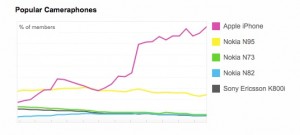
 A few days ago John Naughton posted this neat characterisation of iPhone's niche (scale isn't clear to me but it tells a story): iPhone is now the most popular camera phone for pictures posted to Flickr.
 A few days ago John Naughton posted this neat characterisation of iPhone's niche (scale isn't clear to me but it tells a story): iPhone is now the most popular camera phone for pictures posted to Flickr.
Subscribe to:
Posts (Atom)

 Posts
Posts

