Showing posts with label Information design. Show all posts

24 June 2014

The sun always shines on...


... the Department of Typography & Graphic Communication, University of Reading (Class of 2014).

27 February 2014

Lent calendars

Looking at Christian Aid's Lent calendars for grown ups...

and for children...

... and think the kids are getting a better deal. (Clever idea, though.)

15 November 2013

Nominet UK's top 100 social technology enterprises


An eclectic list, presented idiosyncratically (the tiled layout, amongst other things, limits each entry to four classification categories; if tile size is of significance that beats me). But an interesting few moments' browsing. Charlie Leadbeater's description of the selection process provides some useful background.

06 November 2013

Making air safety information palatable


Virgin America's recently released air safety video is getting a bit of press at the moment. Fun on first viewing but even then, too long. Thomson's approach (as a holiday company, aimed at a different audience) is probably equally grating after too much exposure but, at least, is shorter.


I can imagine they both hold the viewers' attention longer than a flight attendant miming to a voice over, but wonder if anyone has tested information retention as a result.

27 June 2013

Another day at the office

Department of Typography & Graphic Communication, University of Reading. June 2013

12 June 2013

Writing for the web

Some of our recent work at Centre for Information Design Research for GOV.UK has just been published and blogged. We looked at GOV.UK's internal guidelines for text preparation for the web and provided research background that either supported their guidelines or suggested different approaches to presenting information. Many government web sites are not just providing information, but explaining to people how to do things (make applications, check eligibility, provide evidence etc.) and it is this 'reading to do' that needs particular support in carefully crafted text that is comprehensive but also navigable and concise.

06 November 2012

Obama Romney campaign spend


Thought provoking. Though you may need anti-glare glasses.

Interesting postscript in John Naughton's Observer column on the Obama campaign's use of data to track and tailor their message to specific supporter groups. Presumably also to raise funds.

[via Fast Company]

29 July 2012

Standardising patient charts


The Royal College of Physicians has announced a standard, National Early Warning Signs (NEWS), chart to be used across the NHS, to monitor the vital signs of seriously ill patients, in order to detect any deterioration rapidly and reduce medical errors. No one could doubt the sense in this. Deciding what measures to include in the chart, and how those measures are combined into a score, has been the work of a large committee of medical and patient care and safety practitioners, and the chart itself (above) has been designed in collaboration with an e-learning consultancy. With all the input, such a shame to have missed the potential contribution of an information designer or forms designer who could have increased the chart's legibility and usability.

[via BBC News]

On social science writing

Neuroskeptic, generalising a little unfairly, shows how it shouldn't be done...
In a somatic society which promotes visible, idealized forms of embodiment, men are increasingly being interpellated [sic] as image-conscious body-subjects. Some research suggests that men negotiate appearance issues in complex and varied ways, partly because image concerns are conventionally feminized. However, little research hasconsidered how overweight men construct body projects in the context of weight loss, or how men talk to each other about weight management efforts.


... and how it can be
Modern men face a dilemma: society tells them that they ought to have an attractive body, but they are also warned that being concerned about beauty and body image is a feminine trait. However, little research has considered how overweight men think and talk about weight loss.

[via Dorothy Bishop]

13 June 2012

Granularity at BBC weather

BBC Weather have just released a new, fine-detailed forecast, available in two formats:

Graph, which will be interesting to see when there is a wider temperature range:

...or (should you think you need it) table.

According to Jo Wickremasinghe, product manager for BBC weather, all made possible by richer data, available to the Olympic torch relay and now, kindly, made available to the rest of us.

23 April 2012

Employee manual from heaven...


...according to Mark Barratt. Valve's manual does, indeed, achieve an imaginative (as you might expect) balance of information, inspiration, reassurance, humour and self-deprecation (passing over the section on T-shaped people). A new benchmarking standard.

[Image from BoingBoing]


15 January 2012

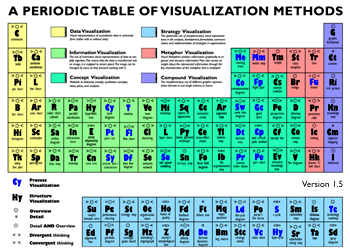
Periodic table of visualisation techniques


Here. Lots of clever detail. Read more from its creators, Ralph Lengler and Martin Eppler, publishing in 2007, here.

[Via Jack Schofield from Visual literacy.org]

06 January 2012

Graphic Medicine

From I am not these feet by Kaisa Leka
...not what you might think, but the use of comic techniques in health and healthcare communication. Ian Williams, Welsh GP and graphic artist, has a web site dedicated to this growing field and has written this article, describing its development.
[via Dentsu]

13 November 2011

QR codes and twitching


Hugo Andrade and David Parra Puente, of the Pacoche Nature Reserve in Ecuador, are trying to connect birdsong with identification information, using QR codes as a mediator between the two: something like Shazam for birdsong. The QR code step may seem a bit clunky but it allows a two-way interaction from song to book, and vice versa, recognising the limitations of typical birdsong descriptions ('tee-do-do-eet') in field guides and, perhaps, that mobile phones have limitations for field consultation.

[Reported by Jennifer Ouelette via NotExactlyRocketScience]

06 November 2011

Isitgoingtoraintomorrow.com

A very direct approach to weather forecasting. For me, 'No' is fine but 'Yes' isn't enough information. How much? When?

19 October 2011

Data visualisation: a chink in the hype

Simon Jones (Guardian Datablog) considers the causes underlying poor quality data visualisation, including the availability of free visualisation softwares, such as Wordle, which generates word 'clouds' (known as the 'mullets of the internet'). But he also links to an unusually interesting word cloud, constructed from American inaugural presidential addresses, in the New York Times. Fascinating.


18 October 2011

Misleading price reduction labels


Yesterday's tabloid press (led by The Times) exposed Tesco's 'Big Price Drop' as a bit less dramatic than Tesco have claimed. Prices that went up a couple of months ago have been reduced, yielding a relatively small, if any, price drop from the original price. This evening I noticed something else going on. The label above implies a comparison of £1.00 with £2.02, whereas the true comparison is £1.00, with £1.01. Price Drop doesn't quite merit its mega type size. A little Dark Patterning, I think.

09 October 2011

iMuse launch


From yesterday's tea party at the Museum of English Rural Life, to launch iMuse, a collaboration between the museum and the charity AACT (Access Ability Communications Technology) to make museums accessible.

In the picture, an attendee is shown how to use QR codes to find out more about the museum's exhibits.

26 September 2011

Extreme ebooks: the Dead Sea Scrolls


A collaboration between Google and the Israel Museum. Not only viewable, in superb detail as you zoom in, but delivering on-line translation and commentary as you select text elements.

[via Engadget]

Generic health charity press release

CELEBRITY! We are very happy to announce that [celebrity] is now our spokesperson/ambassador/patron! S/he is willing to be interviewed on the subject of [disease] which s/he had a “scare” about/has had/had a friend who had it/has always been worried about. As you know, s/he is in the news lately because of Big Brother/football spousal injunction/autobiography/launch of own vajazzaling range. S/he thinks that the current lack of awareness of [disease] is scandalous and is campaigning for more to be done!

Keen observation by GP and commentator on healthcare issues, Margaret McCartney.

[via Dorothy Bishop's Twitter stream]