
Showing posts with label Mobile web. Show all posts
Showing posts with label Mobile web. Show all posts
05 November 2012
Olympic information access

06 January 2012
Digital inequalities
John Naughton reports a NY Times article on wireless bandwidth consumption. Not surprisingly, 10% of users are consuming 90% of the bandwidth...and Finns consume 1 gigabyte of wireless data a month; 10 times the rest of Europe.
31 October 2011
Dynamic passenger WIFI

Tokyo commuters will now have access to local WiFi entertainment and information on their journeys, including being able to see carriage crowding and temperature along their train. It will be interesting to see the impact of that information on passenger behaviour. Would you sacrifice pole position for the platform exit (London Underground passengers bunch up in specific carriages in order to get off the system as quickly as possible) for a cooler carriage?
[From FuelforThoughts via Chris Heathcote]
09 October 2011
iMuse launch

From yesterday's tea party at the Museum of English Rural Life, to launch iMuse, a collaboration between the museum and the charity AACT (Access Ability Communications Technology) to make museums accessible.
In the picture, an attendee is shown how to use QR codes to find out more about the museum's exhibits.
07 March 2011
11 June 2010
Impact of mobile phones on parental communication
NYT article on the distracting effect of mobile phone and laptop use on parental communication with young children. Quotes Sherry Turkle's forthcoming book 'Alone Together' which highlights the isolation and competition young children can experience as they try to attract parents' attention. The article features data from a study by Dana Suskind at U of Chicago showing how the number of words parents say to children (ranging from 11 months to 5 years) tends to drop when they are preoccupied with their phones.
[via John Naughton]
[via John Naughton]
05 May 2010
An internet of things - not yet
This concept, the Copenhagen Wheel, which stores energy when you brake for you to draw on to boost your cycling uphill, gets a pretty rough reception at BoingBoing. Hardy cyclists think it's for whimps, green cyclists point out that the energy cost of manufacture will negate any benefit it might bring by encouraging cycling, others point out that its weight will add to the effort required to ride the bike in the first place, that not enough energy will be captured in braking to give a significant boost, and so on. But the derision reaches crescendo at its control mechanism: an iPhone app, which can also, incidentally, give you feedback about your effort levels and attainment of you personal fitness goals, and share your cycling data with friends (oh, and connect you to a green points club - at this point I had to check this wasn't an April 1 video). These are not the advantages we're looking for in an internet of things.
We know there's mileage (sorry) in things being able to give information about themselves. It's easy to see the fit with tracking in industrial and commercial inventories; healthcare and military applications make sense too. But, as for tracking the details of your cycling, like internet-connected bathroom scales, unless at the extremes of fitness training, there's just too much of the anorak about them at the moment.
I can see, though, applications where connected things will make sense in the future. For example, if we're taxed on our use of certain roads, we might want our car to track its location and mileage (and present those to us coherently) so we can check our bills.
Coincidentally, the issue of the FT, where I first saw the connected scales, also featured an item on the launch of the first remote TV control in 1956. Remote controls didn't seem essential in the UK, at least, until the late 1980s when satellite TV increase the number of channels available and channel hopping became (for some) a way of viewing.
08 October 2009
SMS embedded in everyday life
I reflected recently on how the 'Texting' category of this blog has so few entries, particularly few added recently. Texting is so embedded in everyday life (and the texting multi-taskers I commented on in 2007, so commonplace) that it barely merits comment. To prove the point this post on Mashable reports that in the US 4.1 billion texts were sent daily in the first half of 2009, almost twice the number sent in the same period of the previous year. Even bearing in mind that America has been slower to take up texting than the UK, and sceptical as one might be about the industry's own surveys of itself (this is by CTIA which represents the US mobile industry to government), it's a huge jump. Mobile broadband access is also increasing signicantly.
23 September 2009
New ebook on the block
 The iRex digital reader. Has an alliance with Barnes and Noble and Newspapers Direct. Can handle any publications in ePub format. And wireless connectivity in any geographic location (a challenge to US-bound Kindle).
[via Engadget]
19 September 2009
'Epicollect' mashup of mobile applications and web data
15 September 2009
Uninterpretable data on phone access to web advertising
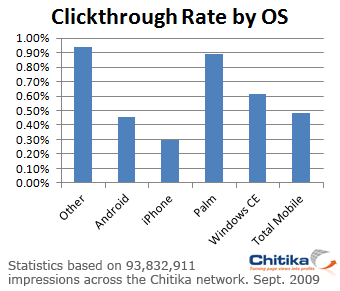
Web advertising company Chitika have published data showing that people are only half as likely to access advertising from mobile phones than from computers. OK. Less easy to interpret is that click through is lower on iPhones than on other operating systems.

In contrast their data confirm other findings that there is more web browsing on iPhones than on other handsets:

So, what explains these strange results? Well, the advertising content tested wasn't particularly tailored to mobile use: none of the context-based offers that typically tempt mobile users. So that explains the main trend in computer access.
On the iPhone versus other handset issue ,it could be that the facility for focusing Safari on the content you are interested in screens out advertising, although some Techcrunch commentators modestly conclude iPhone users are just more discerning than users of other systems. Altogether, hard to interpret.
In contrast their data confirm other findings that there is more web browsing on iPhones than on other handsets:

So, what explains these strange results? Well, the advertising content tested wasn't particularly tailored to mobile use: none of the context-based offers that typically tempt mobile users. So that explains the main trend in computer access.
On the iPhone versus other handset issue ,it could be that the facility for focusing Safari on the content you are interested in screens out advertising, although some Techcrunch commentators modestly conclude iPhone users are just more discerning than users of other systems. Altogether, hard to interpret.
08 September 2009
Mobile web in learning
Round up post on Putting People First of articles on the role of mobile phones in learning, mostly, but not exclusively, in developing countries. The lead article, by Abjihit Kadle, on mobile learning in India makes the point that as devices converge, so will e-learning and m-learning.
07 September 2009
Smartphone web access
Good round up of data from The Guardian on which phones are being used most for mobile web access. Apparently Android phones are overtaking Blackberries and Windows Mobile phones (in the UK), with iPhones still significantly in the lead, and Symbian phones a strong second.
Interesting aside that paid-for apps sell poorly on Android phones compared to iPhones. Somehow this doesn't seem surprising (may be a bit more going on than the Guardian's tentative explanation: iPhone owners have more money).
Interesting aside that paid-for apps sell poorly on Android phones compared to iPhones. Somehow this doesn't seem surprising (may be a bit more going on than the Guardian's tentative explanation: iPhone owners have more money).
03 June 2009
Smartphones, netbooks, laptops
Techcrunch picks up on an article by Joey Devilla arguing that as smartphones get smarter, netbooks will be seen simply as substandard laptops, and eventually become obsolete. The article itself is fun, the debate following Techcrunch's review interesting. Alex Berger captures the issue neatly: smartphones are for data consumption, netbooks for data creation.
10 June 2008
Web sites that morph to complement individuals' style
 Much has been written about a Sloan Management School project to develop web site user interfaces that adapt to users' 'cognitive style' as picked up by their first few clicks (around 10) on the site. So, for example, on a trial marketing site developed for BT, a user with a very analytic approach would get the data sheets (shown left above), someone less analytical would get the advisor interaction (shown right).
Interesting comments in this Technology Review article were that this approach
- could be particularly useful to get users over the problems of limited user interfaces on mobile web sites - by picking up how far the user is prepared to persevere.
- actually defines cognitive style and so differs from existing methods of customising web interactions that rely on similarity between an individual's interactions and others', then presents the individual with options that others have selected.
One thing that worries me about this approach is that people's style may vary from day-to-day, task-to-task (e.g. I rarely scrutinise my utility bills, but occasionally I review what we've been paying, compare with previous years etc.) so there need to be easy routes away from the particular presentation you have been given to what you want at a particular time.
Subscribe to:
Posts (Atom)

 Posts
Posts


