Showing posts with label Design details. Show all posts

23 April 2012

Employee manual from heaven...


...according to Mark Barratt. Valve's manual does, indeed, achieve an imaginative (as you might expect) balance of information, inspiration, reassurance, humour and self-deprecation (passing over the section on T-shaped people). A new benchmarking standard.

[Image from BoingBoing]


18 April 2012

Rugged mobile phones

In past projects as a user experience researcher I could guarantee that in every piece of mobile phone research, no matter what the topic, someone would ask why phones were so flimsy and ask for a robust (and dustproof and loud) phone that could bounce around on the passenger seat of a white van and survive being stepped on by a working boot. JCB have responded.

[via Chris Heathcote's Twitter stream]

28 November 2011

Sketching Apple's first icons

Steve Silberman writes about the sketch books of Susan Kare, who designed the first icons (and proportionally-spaced font) used in the Apple GUI. Silberman discusses how Kare sketched her ideas first on paper, there being no drawing programs available at that point. A nice reminder of how designers' working methods have changed with the development of digital tools.

[via Jason Kottke]

10 November 2011

The limits of gestural interfaces

or this?

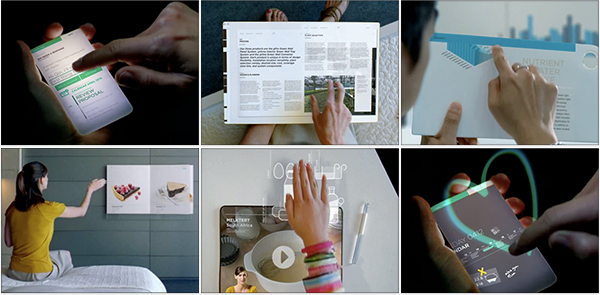
That Microsoft productivity video gets a pasting again. This time from Bret Victor who comments 'Yes - you've got arms! And shoulders, and a torso, and legs, and feet! And they all  move!....with an entire body at your command, do you seriously think the Future of Interaction should be a single finger?'.

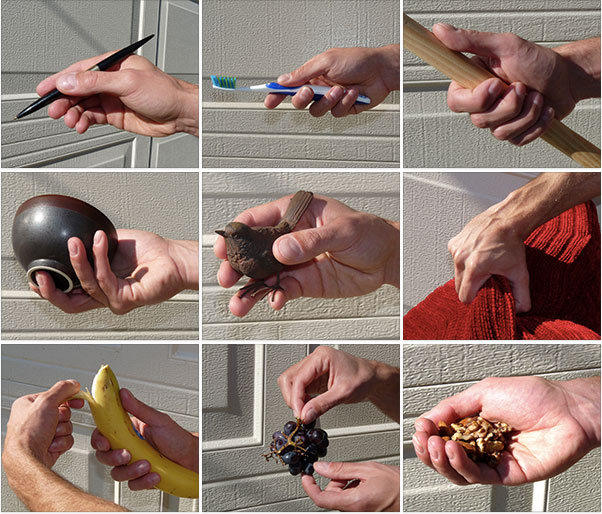
Takes me back to Don Norman's comments on the arbitrary nature of current gestural interfaces.

[via BoingBoing]

06 November 2011

Isitgoingtoraintomorrow.com

A very direct approach to weather forecasting. For me, 'No' is fine but 'Yes' isn't enough information. How much? When?

01 November 2011

The rhetoric of video presentations


John Pavlus, of Fast Company's design blog compares the utopian (dystopian) corporate video style of a recent Microsoft promotional video, Productivity Future Vision, with the innovator/craftsman style, usually showing clever bits of technology embedded in familiar, everyday life, adopted by Berg. Ouch.

On a different tack altogether, it's lovely to see this little piece of video nostalgia to promote a project to preserve Ludlow typecasting matrices.

18 October 2011

Misleading price reduction labels


Yesterday's tabloid press (led by The Times) exposed Tesco's 'Big Price Drop' as a bit less dramatic than Tesco have claimed. Prices that went up a couple of months ago have been reduced, yielding a relatively small, if any, price drop from the original price. This evening I noticed something else going on. The label above implies a comparison of £1.00 with £2.02, whereas the true comparison is £1.00, with £1.01. Price Drop doesn't quite merit its mega type size. A little Dark Patterning, I think.

11 October 2011

Kerning - hours of fun


Honestly. Test your kerning against (other) typographers.

[via Jason Kottke]

19 January 2011

The BBC's take on information visualisation


BBC Newsnight feature on information visualisation (with lovely excerpts from early Open University broadcasts), featuring population statistics star Hans Rosling and also David McCandless, whose work is sometimes, well, more playful than usable. Completely bizarre studio 'debate' between McCandless and Neville Brody, facilitated(?) by Kirsty Wark. Another lost opportunity in mainstream media.

[via Infosthetics]

02 November 2010

Walk-don't walk icons


Have recently returned from Berlin, where the former East Berlin icons for pedestrian crossings (above) have been adopted across the city (with affectionate references in guide books too). Coincidentally I noticed a comparison between Parisian and New York approaches (below) (many other charming, graphic Paris/NY comparisons, too):


Interesting that, whatever the style, the motionless 'don't walk' figure is only really interpretable in the context of its walking partner. Presumably, that's the reasoning behind the authoritarian palm in New York.

[Paris vs New York via Kottke]

18 October 2010

Web design genres


Design Meltdown 2010 is an interesting, growing resource. It collects example web sites under categories (e.g. churches and coffee shops, to name but two) and, at a finer level, lists examples of web site elements (e.g. breadcrumbs, contact forms etc.). Scanning through the category examples reveals some interesting genre characteristics (the archetypical coffee image, above, from 1369 Coffee House, still works).

[via Louise Hewitt, on BrightonNewMedia list]

07 October 2010

Making things difficult for users

Golden Krishna of Cooper Design posts on designing things to be difficult to use, often to deter specific behaviours (e.g. sleeping on airport seating) or to create what you might call a 'side-benefit' (e.g. exercise shoes). (Recently I found a deterent medicine bottle so 'effective' I had to carve off the cap, rendering it unusable.)

Krishna skirts around designing difficulty into information, an enterprise for which I've yet to see a convincing rationale, although he mentions the deliberate use of 'amateurish' styling to create an impression of warmth and localness in web sites. (Perhaps this should be added to Harry Brignull's Dark Patterns, which Krishna also cites, although it's subtler than tricking people into unwittingly providing information about themselves or opting into services.)

Krishna's post led me to re-read Gerard Unger's consideration of legibility in typeface design, written in 1992 when there was a lot of silliness about challenging readers through type design and typography. It's still an excellent read.

The colour of web logos


Intriguing visualisation by colourlovers.com. Apparently the most influential brands on the web cluster in the red and blue areas of the spectrum (although one might argue that covers most options), and competing brands tend to share similar colours. (Have never seen the BBC in red, though that may be as a UK user.) 

Alas, BP.

[via DesignLessBetter]

22 September 2010

The future of interaction design and its ethics

Matt Webb gives his vision of 'What comes after mobile' here. Paraphrasing very crudely: more nuanced, emotionally-based and sensitive interactions between people, information, things and environments, using artificial intelligence as a component of design, with apparently simple interactions often supported by heavy-duty computational resources. At the end of his talk there is an interesting question about the people who do not want to be part of the tagged, networked, tracked world that Webb envisages, and a good response from Webb on the failure, often, to question the ethical implications of design projects.

More directly, Harry Brignull, presents his thoughts on Dark Patterns (see his dedicated web site here), where design gulls users into giving information, signing up for and paying for services etc., often without intending to. Brignull comments on how some UX professionals must be allowing/enabling some of these tricks. Indeed, or pointing out that they're problematic and being ignored.

My own experience is that there can be really awkward situations where the only options is to bow out of a project when you have picked up on factors that are potentially harmful to users (for example compromising personal safety) but your concerns have fallen on deaf ears. Bound by commercial confidentiality, and assuming the intention behind the project isn't criminal, there's nothing else one can do. However you're left with the knowledge that someone else, perhaps more compliant, will take over where you've left off.


[Matt Webb talk via InfoDesign]

07 September 2010

Trust in web sites

Technology Review summarises some research looking at factors that encourage people to divulge personal information on web sites. It's a mixed picture, with research by Alessandro Acquisti at CMU suggesting that the more formal a web site appears, the less likely people are to give personal information. Joseph Bonneau at Cambridge has found that sites that bury privacy settings (i.e. keeping it off users' minds) are likely to get more information from their users (coincidentally, this research was published just as Facebook increased the complexity of its security settings). Tangentially, Soren Preibusch, also at Cambridge, has found that sites which appear to give a high level of privacy can sell products at a higher price than those that don't.

08 August 2010

Shareholder influence on product safety design

FT Weekend features an interview with Cynthia Barlow whose daughter was killed while cycling, by a Readymix lorry cutting across her path as it turned left. Subsequently Barlow bought shares in Cemex, who own Readymix, in order to be able to ask questions at their AGM about the factors leading to her daughter's death. To Cemex's credit they responded positively and worked with Barlow to improve both drivers' awareness of cyclists and other vulnerable road users (through training and the addition of mirrors and sensors along the side of the lorry), and cyclists' ability to detect drivers' signals (additional indicators and voice warnings) when they are alongside the lorries.

06 April 2010

Hot air on Bloomberg screen re-design


Quite a brouhaha on UX magazine, which has picked up an old (2007) report of a conceptual design project run by business magazine, Portfolio. Portfolio asked three design agencies (IDEO, thehappycorp, Ziba) to re-design Bloomberg's rather brutal appearing, classic trader screen.

IDEO's option seems to present the most promising approach but, at this high-level, conceptual stage of development, fails to meet some basic trader needs (e.g. suitability for rapidly spotting patterns and trends, essential to a trader's work). And so it might, after just three weeks in development. Any re-design of a system which has evolved over many years to the current complexity of Bloomberg's would take months of development and refinement and a managed introduction to its users at implementation.

But because of poor reporting and some bogus speculation by UX magazine (e.g. Bloomberg didn't take up IDEO's proposal because its users are entrenched in a difficult interface which makes their task look more complex than it is) many pixels have been spilled both in comments and elsewhere on the web.

A viral storm in a teacup, if ever there was one.

03 February 2010

Two different faces of Apple

Neil Curtis' condensed compilation of the hype at iPad's launch last week. [via John Naughton]

In contrast, Jonathan Ive quietly considering the design obsessiveness that makes the hype possible. [via Nordkapp]

05 October 2009

Design (and context) cue the wrong behaviour

Design Sojourn spotted how the design of this vertical hand dryer cues the wrong response as people use it for discarded paper towels. No mouldings or information graphics to cue the correct response (as in Dyson's version). In fact the product name Clean Dry could almost suggest this is where you put used paper towels.
One of the people commenting on Design Sojourn's posting notes that they find it awkward putting their hands vertically into a dryer. I wonder. I think it's the action of putting your hand into an aperture that puts some people off. At least this way you can see your hands. With a horizontal aperture, you can't. Wouldn't be able to see into the dryer to clean it properly either. Presumably with the vertical arrangement gravity assists the process of blowing water off your hands. And a vertical form doesn't intrude so far into the roomspace.

[via Futurelab]

15 September 2009

Uninterpretable data on phone access to web advertising

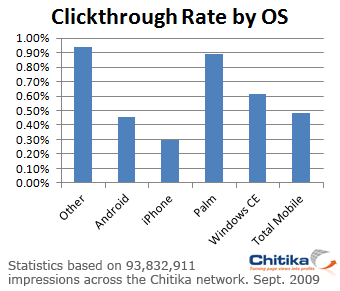
Web advertising company Chitika have published data showing that people are only half as likely to access advertising from mobile phones than from computers. OK. Less easy to interpret is that click through is lower on iPhones than on other operating systems.


In contrast their data confirm other findings that there is more web browsing on iPhones than on other handsets:

So, what explains these strange results? Well, the advertising content tested wasn't particularly tailored to mobile use: none of the context-based offers that typically tempt mobile users. So that explains the main trend in computer access.

On the iPhone versus other handset issue ,it could be that the facility for focusing Safari on the content you are interested in screens out advertising, although some Techcrunch commentators modestly conclude iPhone users are just more discerning than users of other systems. Altogether, hard to interpret.